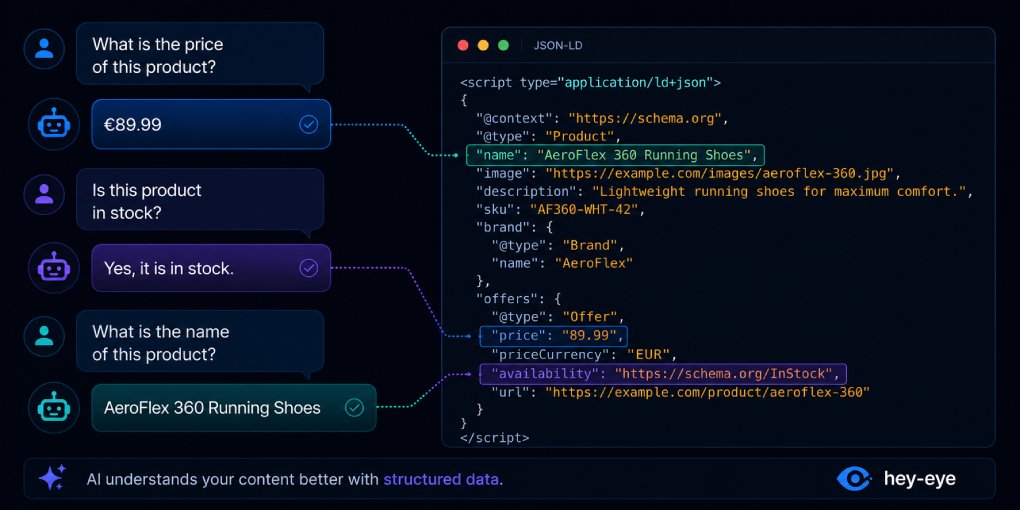
When someone asks an LLM a question, the model searches for the most directly answerable content it can find. A page with FAQPage schema hands the model exactly what it wants: pre-packaged question-answer pairs, structured in a format that requires zero interpretation.
No other schema type maps this directly to how people use AI assistants. That’s why FAQPage is the single highest-impact schema for AI citations.
Why FAQ schema works so well for LLMs
LLMs process queries as questions. A user types “what is AI extractability?” and the model looks for content that answers that exact question. Without FAQ schema, the model has to scan your entire page, locate the relevant paragraph, and extract the answer from surrounding context.
With FAQ schema, the model finds a structured block that literally says: “Question: What is AI extractability? Answer: AI extractability measures how easily…” The match is instant. The extraction is clean. The attribution is direct.
This is why pages with FAQ schema get cited disproportionately often. The model doesn’t have to work to find the answer. You’ve already done that work in your markup.
When to use FAQPage schema
FAQPage schema is appropriate when your page genuinely answers multiple distinct questions. It works well on:
Dedicated FAQ pages. The obvious use case. If you have a page that lists common questions about your product or service, it should have FAQPage schema.
Blog posts that answer questions. An article titled “Everything You Need to Know About llms.txt” naturally answers several questions. Each H2 section that addresses a specific question can be represented as a FAQ entry.
Product pages with common questions. “Does this product support X?” “What’s the return policy?” “Is it compatible with Y?” These are natural FAQ entries that agents extract for comparison shopping.
Service pages. “How long does it take?” “What’s included?” “Do you offer support?” Converting these into structured FAQ pairs makes them instantly extractable.
Don’t use FAQPage schema on pages that don’t genuinely answer questions. A company history page or a team bio page isn’t a FAQ, and marking it as one sends misleading signals.
Implementation
A basic FAQPage schema looks like this:
{
  "@context": "https://schema.org",
  "@type": "FAQPage",
  "mainEntity": [
    {
      "@type": "Question",
      "name": "What is AI extractability?",
      "acceptedAnswer": {
        "@type": "Answer",
        "text": "AI extractability measures how easily language models can find, isolate, and cite specific pieces of content from your page. It depends on structural signals like heading hierarchy, paragraph length, schema markup, and internal linking."
      }
    },
    {
      "@type": "Question",
      "name": "How do I improve my extractability score?",
      "acceptedAnswer": {
        "@type": "Answer",
        "text": "Add JSON-LD schema to your pages, use clear H1-H2-H3 heading hierarchy, keep paragraphs under 100 words, include definitional statements, and add internal links to related content."
      }
    },
    {
      "@type": "Question",
      "name": "Does AI extractability affect Google rankings?",
      "acceptedAnswer": {
        "@type": "Answer",
        "text": "Not directly. AI extractability affects how AI systems like ChatGPT, Claude, and Gemini cite your content. However, many extractability best practices (clean structure, schema markup, fast loading) also benefit traditional SEO."
      }
    }
  ]
}
Place this inside a <script type="application/ld+json"> tag in your page’s head section.
Writing answers that get cited
The answer text in your schema is what models extract and quote. Writing it well is the difference between getting cited and being ignored.
Answer the question directly in the first sentence. Don’t start with context or background. The first sentence should be a standalone answer. Everything after it is supporting detail.
Keep answers between 50 and 150 words. Shorter than 50 and the answer lacks enough substance to be useful. Longer than 150 and the model has to truncate or summarize, which reduces attribution accuracy.
Match the visible content. Your schema answers should match what’s actually on the page. Google penalizes mismatches between schema content and visible content. More practically, a mismatch confuses models about which version to trust.
Use the exact question phrasing your audience uses. Don’t write “What is the nature of AI-driven content extraction?” when your audience searches “how do I make my content visible to AI?” Use the language real people type into search bars and chat windows.
Combining FAQ with Article schema
You don’t have to choose one or the other. A blog post can have both Article schema (describing the post metadata) and FAQPage schema (structuring the Q&A content within it). They serve different purposes and both enhance AI extractability.
The Article schema tells models what the page is: who wrote it, when it was published, what the topic is. The FAQ schema tells models what questions it answers and what those answers are. Together, they give AI systems both context and content.
Common mistakes
Too many questions. Listing 50 questions dilutes the signal. Stick to 5-10 of the most important questions per page. If you have more, split them across multiple pages.
Answers that don’t answer. “Contact us to learn more” is not an answer. If you can’t answer the question in the schema, don’t include it.
Questions nobody asks. Every question in your schema should reflect something real users actually search for. Check your Search Console queries, Google’s People Also Ask, and AI-powered tools like Questions People Are Asking to find real questions.
Duplicate questions across pages. If the same Q&A pair appears in schema on multiple pages, models don’t know which to cite. Each question should appear in schema on exactly one page.
Validate and measure
After implementing FAQ schema, verify it with Google’s Rich Results Test and run the page through hey-eye to check the AI Extractability pillar. The score should improve immediately. Generate your schema quickly with the hey-eye JSON-LD generator if you want a starting template.
FAQ schema is the closest thing to a guaranteed citation improvement. It gives models the exact format they need, with zero extraction effort required.