Meta tags feel like a solved problem. Title tag, meta description, maybe some Open Graph tags for social sharing. SEO basics covered in every beginner guide since 2010. Nothing new to learn here.
Except that LLMs use meta tags differently than search engines, and the tags you’ve been ignoring might be the reason AI systems skip your content.
How LLMs use meta tags
When a search engine crawls your page, it reads your meta tags as ranking hints. The title tag influences rankings. The meta description might appear as the snippet. But Google ultimately makes its own decisions about what your page is about based on the full content.
LLMs are less independent. When an AI crawler fetches your page, it needs to make a fast triage decision: is this page relevant to the current query? Should I process the full content or move on to the next result?
Meta tags are the triage layer. Before an LLM processes your 2,000-word article, it reads your title tag, meta description, and Open Graph tags to determine relevance. If these tags are missing, generic, or misleading, the model may skip your page entirely, even if the content underneath is excellent.
This is the difference: Google reads meta tags as supplementary signals among hundreds of others. LLMs read meta tags as primary pre-screening signals that determine whether full content processing happens at all.
The tags that matter
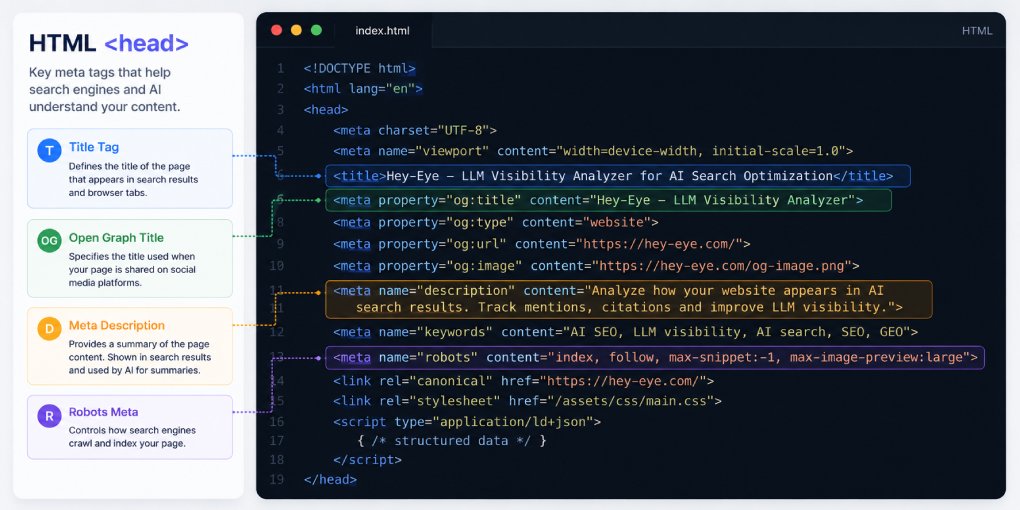
Title tag. The single most important meta element. LLMs use it as the primary topic identifier. A missing title tag is like a book with no cover. The model has to read the content to know what it’s about, and most models won’t invest that effort when thousands of other pages have clear titles.
Your title should state the topic explicitly. “Our Approach” tells an LLM nothing. “How to Generate JSON-LD Schema for Any Page” tells it exactly what the page covers and whether it matches the current query.
Meta description. Search engines sometimes ignore meta descriptions and generate their own snippets. LLMs rarely do this. They use your description as a content summary that helps them decide whether to process the full page.
Write descriptions that summarize the actual content, not marketing pitches. “We offer world-class solutions” is useless to an LLM. “Step-by-step guide to implementing FAQ schema with ready-to-use JSON-LD examples” gives the model a precise content preview.
Open Graph tags. og:title, og:description, og:image, and og:url were designed for social media previews. But AI systems read them too, especially when the standard title or description is missing or unclear. OG tags serve as a backup metadata layer that many sites neglect.
og:type is particularly useful. It tells AI systems whether the page is an article, product, website, or other content type. This classification helps models process the page with the right expectations.
Canonical URL. The canonical tag tells AI systems which version of a page is authoritative. Without it, models might encounter your content at multiple URLs (www vs non-www, HTTP vs HTTPS, with or without trailing slash) and not know which to cite. This can split your citation equity across duplicate versions.
Meta robots. The index, follow directive explicitly tells AI systems your page should be discoverable and its links should be followed. While this is the default behavior, explicit declaration removes ambiguity. Conversely, a noindex tag tells both search engines and AI crawlers to exclude the page.
Language attribute. Technically an HTML attribute, not a meta tag, but it functions as metadata. The lang="en" attribute on your html tag tells AI systems which language model to apply. A Greek page without a language declaration might be processed with English assumptions, degrading extraction quality.
The tags that don’t matter for AI
Meta keywords. Dead for Google since 2009, equally irrelevant for LLMs. No AI system uses the keywords meta tag for any purpose.
Meta author. Some sites use <meta name="author">. LLMs don’t reliably parse this. Author information in JSON-LD schema is far more effective because it’s structured and standardized.
Viewport and charset. Essential for browsers but not relevant to AI extraction. Keep them for web standards compliance, but don’t expect them to influence AI visibility.
Common meta tag mistakes
Duplicate titles across pages. If your blog posts all have the title “Blog | YourSite,” every page looks identical to an AI system. Each page needs a unique, descriptive title that distinguishes it from every other page on your site.
Missing OG tags. Many developers add title and description but skip Open Graph entirely. Since OG tags serve as a metadata backup layer, missing them means one fewer signal for AI systems to work with.
Description that doesn’t match content. A meta description that promises “complete guide to schema markup” on a page that briefly mentions schema in one paragraph is misleading. AI systems that discover the mismatch lose trust in your metadata and may deprioritize your site for future queries.
Truncated titles. Titles over 60 characters get cut off in search results, but they’re fully readable by AI systems. Don’t sacrifice clarity for character count. A descriptive 70-character title is better for AI visibility than a vague 55-character title, even if Google truncates the display.
No canonical on paginated content. Pagination pages (page 2, page 3) without proper canonical tags create duplicate content signals. Set canonical to self for each pagination page, or use noindex with follow to keep them out of indexes while maintaining link equity.
The meta tag audit
Check your key pages for these signals:
- Does every page have a unique title tag that describes its specific content?
- Does every page have a meta description that accurately summarizes what the page covers?
- Are og:title, og:description, og:image, and og:url present on every page?
- Does every page declare a canonical URL?
- Is the html lang attribute set correctly?
Run your pages through hey-eye to check these automatically. The Structural Integrity pillar evaluates title tags, canonical URLs, Open Graph completeness, and meta robots directives. Missing or misconfigured meta tags show up as specific failed checks with clear fix recommendations.
Generate complete, properly formatted meta tags for any page with the hey-eye Meta Tags Generator. It creates title, description, Open Graph, Twitter Card, and canonical tags in one step.
Small tags, large impact
Meta tags take five minutes to add and never need updating unless the page content changes. They’re the lowest-effort, highest-certainty improvement you can make for AI visibility. Unlike content quality or backlink building, meta tags are entirely within your control and the results are immediate.
Every page on your site should have complete meta tags. Not because Google requires them. Because the AI systems that increasingly drive discovery use them as the first signal of whether your page is worth reading.