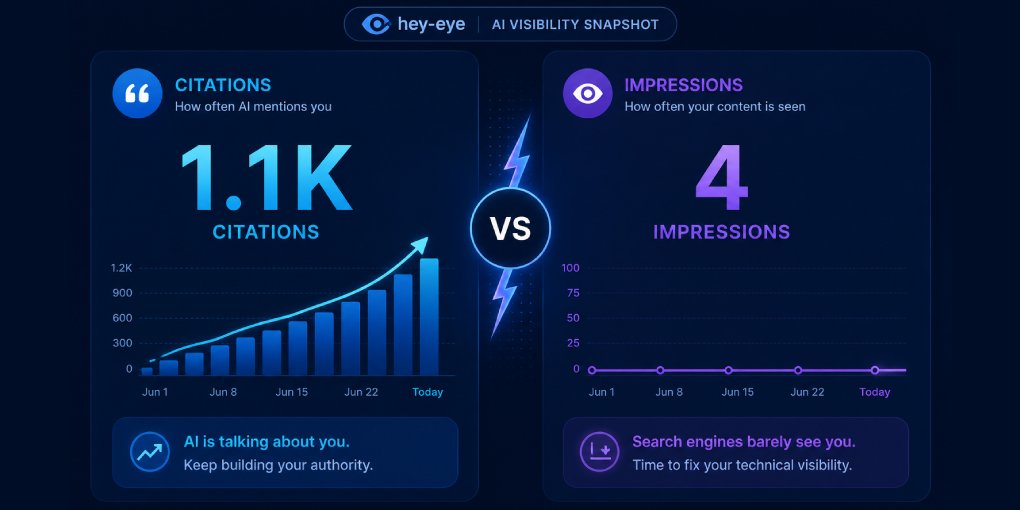
We checked our Bing Webmaster Tools last week. The traditional search numbers were modest: 4 impressions in 30 days. Not surprising for a niche tool that targets a specific audience.
Then we opened the AI Performance tab.
1,100 AI citations. Same 30-day period. An average of 4 cited pages per citation. Our content was being referenced by AI systems dozens of times per day, across multiple pages, while traditional Bing search barely knew we existed.
Two channels, two realities
Traditional search and AI search are not the same channel. They don’t use the same ranking factors, they don’t surface the same content, and they don’t reflect the same user behavior.
In traditional Bing search, we had almost no presence. Four impressions means our pages appeared in search results roughly once a week. Effectively invisible.
In AI-powered search, we were cited over a thousand times. AI systems were pulling our content, referencing our pages, and presenting our information to users who never saw us in a search results page.
This gap isn’t a bug. It’s how the new landscape works. Traditional search rankings depend on backlinks, domain authority, and keyword competition built over years. AI citations depend on content structure, schema markup, and machine readability, things you can optimize today.
Why AI systems cited us
Looking at the data, the cited pages were consistently our most structurally optimized content: pages with complete JSON-LD schema, clean heading hierarchies, short paragraphs, and explicit definitional statements.
The content that got cited wasn’t our longest or most comprehensive. It was our best-structured. Pages where every section had clear H2 headings, every concept was explicitly defined, and every piece of metadata was properly declared.
This aligns with what we’ve been writing about in this blog: AI systems don’t read like humans. They extract. And they extract most efficiently from content that’s structurally optimized for extraction.
What the “4 pages per citation” means
The average of 4 cited pages per citation tells us something important: AI systems aren’t just grabbing one page and moving on. They’re navigating our site, following internal links, and pulling information from multiple pages to construct responses.
This validates the topical cluster approach. When an AI system finds one well-structured page on a topic, it follows the internal links to related pages and cites those too. A single strong page becomes an entry point to your entire content ecosystem.
Sites with isolated pages and no internal linking don’t get this compounding effect. Their single page might get cited once, but the AI system has no path to discover related content.
What you can learn from this
If you’re only tracking Google Search Console and Google Analytics, you’re blind to an entire channel. Here’s how to see it:
Check Bing Webmaster Tools. Go to the AI Performance section. If you haven’t verified your site in Bing, do it today. The AI citations data is exclusive to Bing Webmaster Tools and isn’t available anywhere else.
Compare the numbers. Look at your traditional search impressions versus your AI citations. The gap might surprise you. You might be getting cited hundreds of times by AI systems while showing up in zero traditional search results.
Identify which pages get cited. Bing shows you the cited pages breakdown. Are they your best-structured pages? Your newest content? Your oldest? The pattern reveals what AI systems value in your content.
The strategic implication
If AI citations are growing while traditional search is flat, the investment priority is clear: optimize for AI extraction.
That doesn’t mean abandoning SEO. It means recognizing that structural optimization (schema, headings, content clarity, metadata) serves both channels, while traditional SEO tactics (link building, keyword density) serve only one.
Run your most-cited pages through hey-eye and look at what they have in common structurally. Then apply those same patterns to your remaining pages. The citations will follow.
Check your own AI Performance
If you haven’t looked at your Bing AI Performance data yet, you might be sitting on similar numbers without knowing it. AI systems are citing content across the web right now, and the only way to see it is to check.
Go to Bing Webmaster Tools, open AI Performance, and see where you stand. Then run your top pages through hey-eye to understand why they’re being cited and how to get more of your pages into that cycle.
The citations are happening whether you track them or not. But you can only optimize what you measure.