Knowing your competitors rank above you in Google is one thing. Knowing they get cited by ChatGPT while you don’t is another. Traditional competitor analysis tracks keywords and backlinks. LLM competitor benchmarking tracks structural readiness: who is better packaged for AI extraction, and why.
Here’s a repeatable framework you can run monthly.
Step 1: Identify your LLM competitors
Your LLM competitors aren’t always your SEO competitors. A niche site with perfect schema and clean structure might outperform a major brand with a bloated, JavaScript-heavy frontend.
Start by asking the major LLMs questions in your space. Open ChatGPT, Claude, and Perplexity and ask the same five questions your customers would ask. Write down which sources get cited. These are your actual LLM competitors.
You’ll likely find some familiar names and some surprises. A small blog with strong structured data might appear alongside enterprise sites with entire SEO teams. In AI search, structure beats scale.
Step 2: Map your competing pages
For each competitor identified in Step 1, find the specific pages that compete with yours. Match them by topic, not by domain. Your blog post about JSON-LD schema competes with their blog post about JSON-LD schema, not with their homepage.
Create a simple spreadsheet with three columns: your URL, their URL, and the topic. Aim for 10-15 page pairs that cover your most important topics.
Step 3: Run side-by-side comparisons
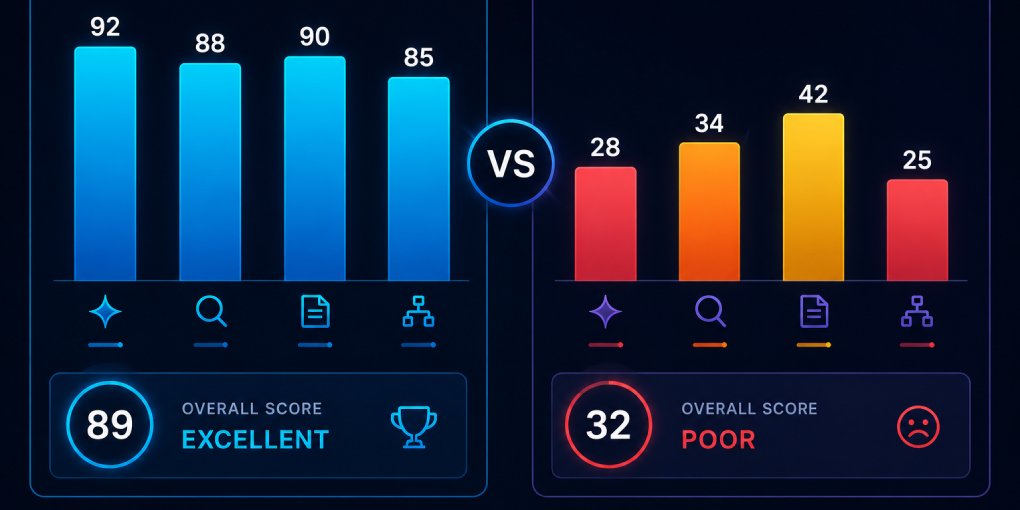
Use the hey-eye Compare tool to analyze each page pair. For every pair, you get a pillar-by-pillar breakdown showing exactly where you win, lose, or tie.
Record the results in your spreadsheet. Add columns for each pillar score (Structural Integrity, AI Extractability, Content Clarity, Authority & Trust) for both your page and the competitor’s page.
Step 4: Find the patterns
With 10-15 comparisons complete, patterns emerge quickly:
Pillar-level patterns. If you lose on AI Extractability in 12 out of 15 comparisons, schema markup is your systematic weakness. If you consistently win on Content Clarity but lose on Structural Integrity, your writing is strong but your HTML needs work.
Check-level patterns. Drill into the individual checks within each pillar. Maybe every competitor has breadcrumb markup and you don’t. Maybe they all use FAQ schema on guide pages and you use only Article schema. These recurring gaps are your highest-leverage fixes because closing them improves every page at once.
Template-level patterns. If all your blog posts score similarly and all your product pages score similarly, the issue is in your templates, not your content. Fixing the template fixes every page that uses it.
Step 5: Prioritize by impact
Not every gap is worth closing. Prioritize based on two factors:
Impression volume. Check your Search Console data. Pages with high impressions and poor LLM visibility scores should be fixed first because more people are searching for those topics.
Fix difficulty. Adding JSON-LD schema is a 10-minute fix. Restructuring a 3,000-word article into proper heading hierarchy takes an hour. Rank your gaps by effort required and start with quick wins.
A simple priority matrix: high impressions + easy fix = do this week. High impressions + hard fix = schedule this month. Low impressions + easy fix = batch and do together. Low impressions + hard fix = backlog.
Step 6: Implement and re-measure
Fix the top five gaps. Then re-run the comparisons. This is critical because optimization isn’t a one-way process. Your changes might improve one pillar while accidentally regressing another. A before-and-after comparison catches regressions immediately.
Track your scores over time using Scan History. Create a monthly snapshot of your key pages’ scores so you can see whether the gap is closing or widening.
Step 7: Repeat monthly
Your competitors are optimizing too. A gap you closed last month might reopen if a competitor improves their structure. A new competitor might appear that you hadn’t tracked before.
Run the full benchmarking cycle monthly. Keep the same spreadsheet and add new columns for each month’s scores. Over time, you build a trend line that shows whether your AI visibility is improving relative to competition, not just in absolute terms.
The framework in practice
Run your first benchmark this week. Pick five topics, find the competing pages, and run the comparisons in hey-eye. The entire process takes about an hour for five page pairs, and the insights are immediately actionable.
The sites that benchmark regularly are the ones that improve consistently. The ones that check once and forget fall behind without realizing it.