Analyzing one page gives you a score. Analyzing your entire site gives you a strategy.
A single-page analysis tells you whether that specific URL is structured for LLM extraction. But it doesn’t tell you whether the rest of your site is dragging it down, which pages are your strongest assets, or where the biggest gaps are hiding. That’s what a website audit does.
What an AI visibility audit covers
A website audit crawls your sitemap and runs every page through the same analysis an individual scan would perform. But instead of one score, you get a complete map of your site’s AI readiness. You can check yours through hey-eye Website Audit.
For each page, the audit evaluates all four pillars: Structural Integrity, AI Extractability, Content Clarity, and Authority & Trust. The result is a sortable list of every page on your site with individual scores, letting you see patterns that single-page analysis can’t reveal.
You might discover that your blog posts score consistently high on clarity but low on schema markup. Or that your product pages have strong structured data but poor heading hierarchy. Or that your landing pages, the ones you spent the most money on, are actually your worst performers for AI visibility because they’re built with JavaScript frameworks that LLMs can’t parse.
These patterns only become visible at the site level.
How it differs from a traditional SEO audit
Traditional SEO audits check for broken links, missing meta tags, duplicate content, page speed, and crawl errors. An AI visibility audit shares some of those checks but adds a layer that traditional tools don’t cover.
Specifically, an AI visibility audit evaluates:
Schema completeness. Not just whether schema exists, but whether the right schema type is used for each content type. A blog post with Product schema is worse than no schema at all.
Heading hierarchy quality. Not just whether headings exist, but whether they follow a logical H1 > H2 > H3 sequence that creates usable chunk boundaries for LLMs.
Paragraph extractability. Whether your content is organized in self-contained units that a model can pull individually, or whether ideas span multiple paragraphs with no clean extraction points.
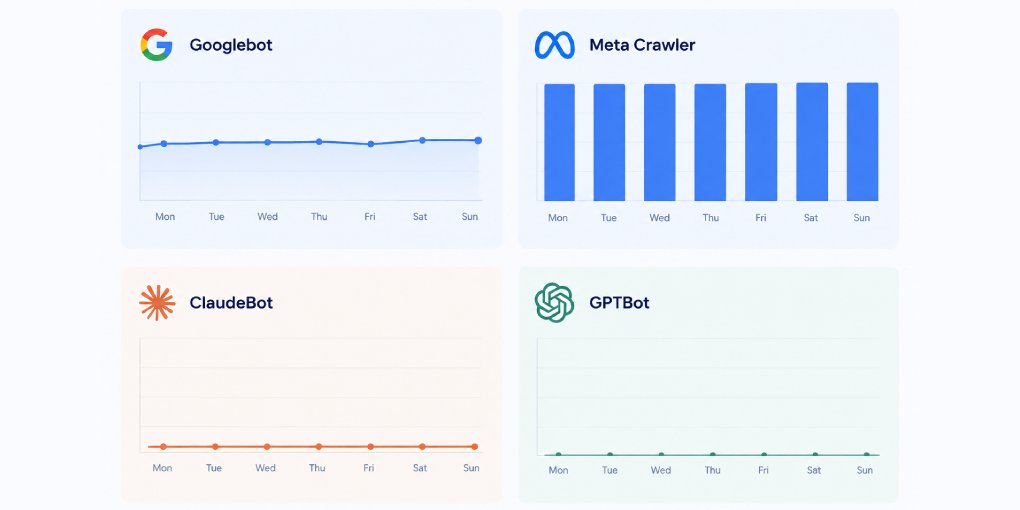
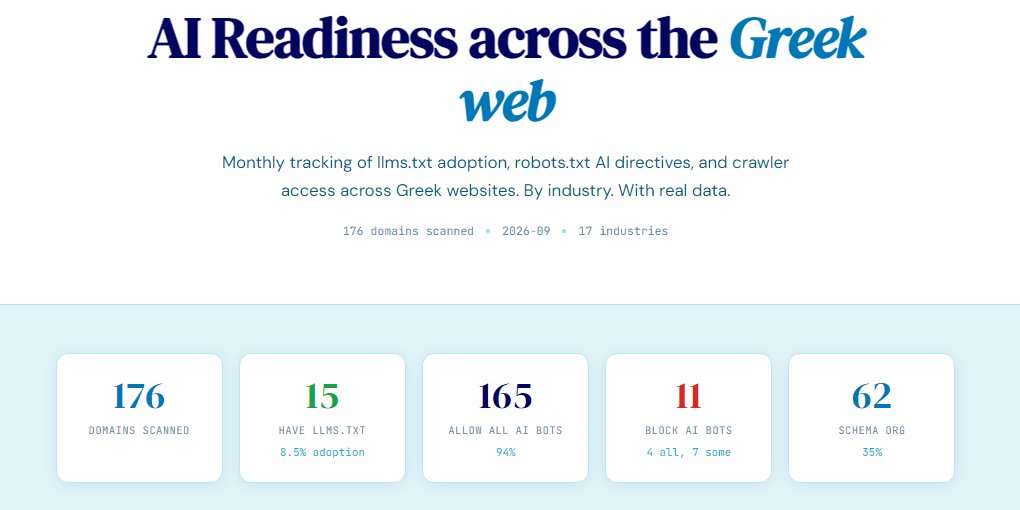
AI crawler access. Whether your robots.txt and meta robots directives actually allow the AI crawlers that matter. A page might be fully indexed by Google but completely invisible to GPTBot and ClaudeBot.
Agent readiness signals. Whether your site provides the discovery files (llms.txt, MCP Server Card, Agent Skills Index) that AI agents look for when deciding whether to interact with your site.
Traditional SEO tools don’t check any of these. They’re optimizing for a search paradigm that’s being supplemented, and in some queries replaced, by AI-powered discovery.
What the results tell you
A completed audit gives you several actionable insights:
Your weakest pillar across the site. If 80% of your pages score below 50 on AI Extractability, you know that schema markup and content structure are your priority, not more content.
Your best and worst pages. The top-scoring pages reveal what you’re already doing right. The bottom-scoring pages reveal where quick fixes will have the most impact. Often, fixing the worst pages is easier and more impactful than improving pages that already score well.
Consistency gaps. A site where some pages score 90 and others score 20 has a consistency problem. LLMs evaluate sites holistically. A few excellent pages surrounded by poor ones reduce the perceived quality of the entire domain.
Content type patterns. You might find that all your blog posts score well but all your landing pages score poorly, or vice versa. This tells you which templates or content workflows need attention.
Running an audit with hey-eye
The hey-eye Website Audit crawls your sitemap and analyzes every page it finds. Enter your domain, and the tool discovers your sitemap automatically, processes each URL, and returns a comprehensive scorecard.
The results show each page’s total score and per-pillar breakdown. You can sort by overall score to find your weakest pages, or sort by a specific pillar to find targeted optimization opportunities. Pages that fail specific checks include actionable recommendations for fixing the identified issues.
For ongoing monitoring, scores from each audit are stored in your Scan History, so you can track improvements over time and verify that fixes are having the intended effect.
When to run one
Run a full audit in these situations:
Before a content strategy push. Before you invest in new content, understand how your existing content performs. You might find that optimizing ten existing pages delivers more AI visibility than publishing ten new ones.
After a site redesign. Template changes, CMS migrations, and design refreshes often introduce structural regressions. A post-redesign audit catches problems before they affect your visibility.
Quarterly, as a health check. AI visibility standards evolve. New discovery files become expected, schema requirements tighten, and scoring models update. A regular audit keeps you current.
When traffic from AI channels is flat. If your analytics show growing traffic from traditional search but flat or declining traffic from AI-powered sources, an audit will reveal the structural reasons.
Start with the gaps
You don’t need to fix everything at once. Run the audit, sort by lowest score, and start with the five worst pages. Fix their structural issues, re-scan, and move to the next five. Incremental improvement at the site level compounds faster than perfecting individual pages.
Run your first audit at hey-eye.gr/website-audit and see where your site really stands.