You already know your Google rankings. You track your competitors’ backlinks, their keyword positions, their domain authority. But do you know how they show up when someone asks ChatGPT, Claude, or Gemini a question in your space?
LLM visibility is a different game. The rules are different, the signals are different, and most of your competitors haven’t figured that out yet. That’s your window.
Why competitor analysis matters for AI visibility
When an LLM generates a response, it doesn’t return ten blue links. It synthesizes one answer, sometimes citing sources, sometimes not. The content that gets cited tends to share specific structural qualities: clean markup, strong schema, clear headings, and high trust signals.
If your competitor’s page gets cited and yours doesn’t, the gap isn’t always about content quality. It’s often about how that content is packaged. Competitor analysis helps you find exactly where those structural gaps exist.
Step 1: Identify your real LLM competitors
Your LLM competitors aren’t always your SEO competitors. A niche blog with perfect schema markup might outperform a major brand with a messy HTML structure.
Start by asking the major LLMs questions in your space. Note which sources get cited or referenced. These are your actual competitors in the AI visibility landscape. You might be surprised by who shows up.
Step 2: Run a side-by-side analysis
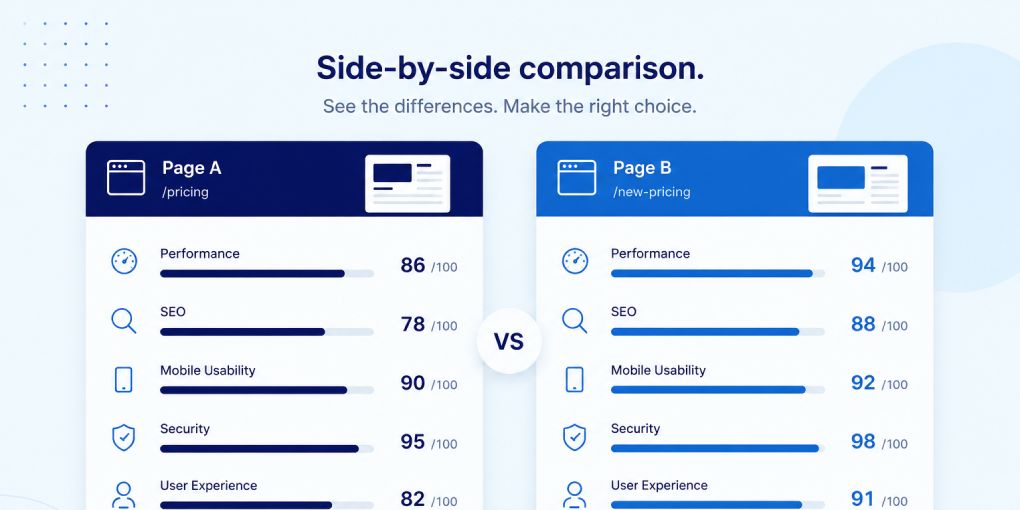
Use hey-eye’s Compare mode to analyze two pages simultaneously. Enter your URL and a competitor’s URL that targets the same topic. The tool scores both pages across all four visibility pillars and shows you exactly where you win, lose, or tie.
Pay attention to the pillar-level breakdown. You might score higher on Content Clarity but lose badly on AI Extractability because your competitor has JSON-LD schema and you don’t. That’s an actionable gap you can close in an afternoon.
Step 3: Audit their entire site
For a broader view, run a Website Audit on your competitor’s domain. This crawls their sitemap and returns an aggregate LLM visibility score for every page. You’ll quickly see which of their pages are best optimized for AI extraction and which patterns they use consistently.
Look for patterns across their top-scoring pages. Do they all use FAQ schema? Do they keep paragraphs under 100 words? Do they have breadcrumb markup on every page? These patterns reveal their optimization strategy, whether intentional or accidental.
Step 4: Find the structural gaps
The most common gaps between competitors usually fall into a few categories:
Schema markup. One site has JSON-LD (FAQPage, HowTo, Article) and the other doesn’t. This is the single biggest differentiator in AI extractability scores.
Heading hierarchy. One site uses clean H1 > H2 > H3 structure while the other has flat content with no subheadings. LLMs chunk content by headings, so poor hierarchy means poor extraction.
Trust signals. Author attribution, About page links, social profiles. These signals help LLMs evaluate source credibility. Many sites ignore them entirely.
Content structure. Short paragraphs, lists, definitional patterns (“X is a…”). These make content easier for LLMs to extract and quote directly.
Step 5: Track your progress
After implementing fixes, use Scan History to track your scores over time. Run the same comparison periodically to see if you’re closing the gap. LLM optimization isn’t a one-time fix but a continuous process, just like traditional SEO.
The competitive advantage is structural
Most businesses are still focused exclusively on traditional search rankings. The ones that start optimizing for LLM visibility now will have a significant head start. The content doesn’t need to change. The structure does.
Run a free comparison of your page against a competitor’s and see exactly where you stand. The gaps you find today are the wins you ship tomorrow.