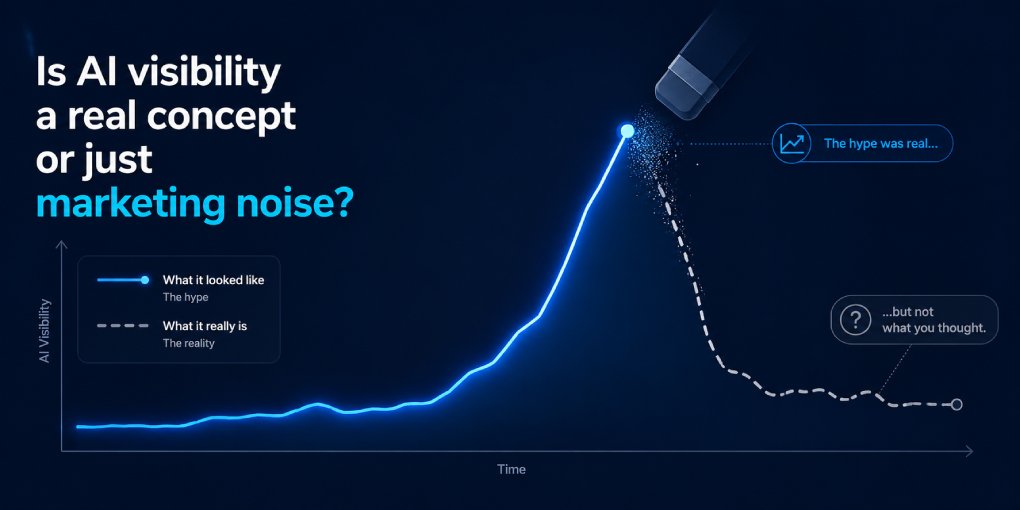
There is a reasonable case that AI visibility is a term invented to sell things.
It arrived fast. It has at least four competing acronyms. It is promoted mostly by people who sell tools and services for it. And the metrics it relies on are supplied by the same platforms whose behaviour nobody can audit.
That is the shape of a hype cycle. So it is worth asking honestly which parts of this hold up.
Start with what is verifiable
Some claims in this space can be checked without trusting anyone.
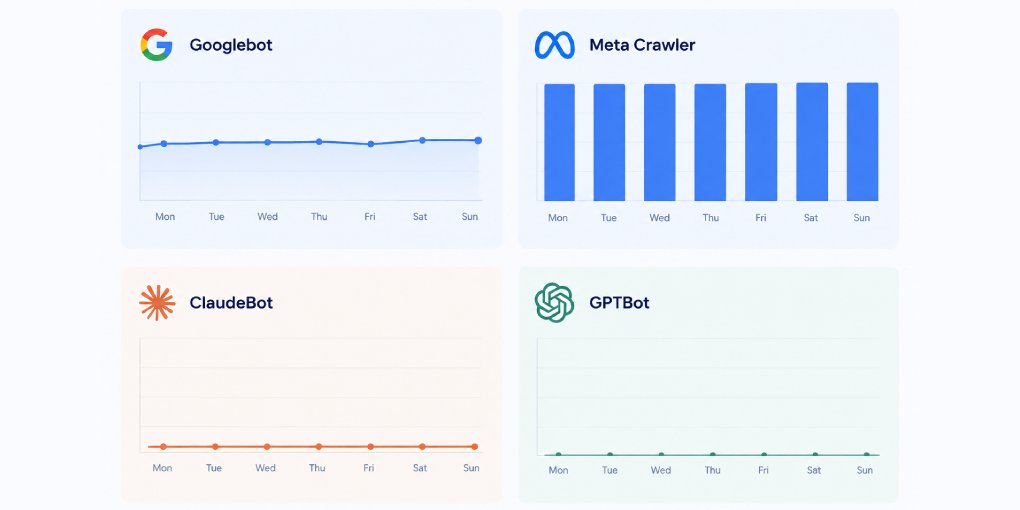
AI systems fetch web pages. You can verify this in your own server logs, with one condition: verify the source, not the label. A user agent is a free-text header anyone can fake, and when I checked my own traffic, 94% of requests claiming to be GPTBot came from somewhere else. The genuine ones are confirmed by IP ranges the operators publish, or by reverse DNS. Once you filter for those, what remains is real crawler traffic, not a theory.
Those systems cite sources. Ask any AI assistant a question and it will name pages. Those pages are real, the links work, and some of them belong to somebody who did nothing special to earn the mention.
And structure affects what gets extracted. This one is testable directly. Take a page with no headings, no schema, and 200-word paragraphs. Ask a model to answer a specific question from it. Then restructure the same content and ask again. The difference in how cleanly the model isolates and attributes the answer is observable without any tool in between.
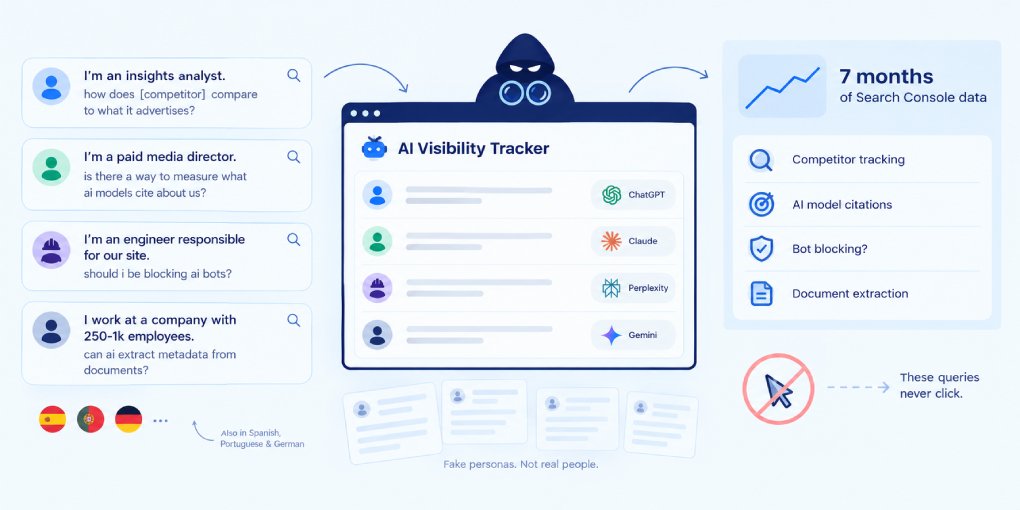
And AI systems search on your topic at scale. Search Console now shows queries that no person typed: full questions with line breaks, leftover system instructions, and prompts written in the voice of specific buyer personas, from “i’m an insights analyst” to “i work at a company with 250-1k employees.” I wrote about the first of these here. Whatever is sending them, they are machine-generated retrieval, visible in a report you already have.
None of that requires believing a vendor.
Now the part that does not hold up
“AI visibility score” as an absolute number. Nobody has access to how any model ranks or selects sources. Every score, including ours, is a proxy built from observable structural signals. It correlates with extractability. It is not a measurement of citation probability, and anyone presenting it as one is overclaiming.
Guaranteed placement in AI answers. Model outputs are non-deterministic. The same question asked twice can cite different sources. Anyone promising you a spot is selling something they cannot deliver.
Model-specific optimization services. Tactics tuned to one model’s current behaviour break with the next release. The underlying structural work is general, and the model-specific layer on top is mostly repackaging.
Urgency framing. “The window is closing” appears in most content on this topic, including some of ours. It is a persuasion device more often than an observation.
The measurement problem, from our own data
This is where we have to include ourselves in the criticism.
In July we published an article about our Bing AI Performance data. It showed 1,726 AI citations against 36 Google clicks over the same period, with citations sitting near zero through May and then jumping sharply on June 1. We read that jump as evidence that our content work was paying off in a channel traditional analytics could not see.
We were wrong.
Microsoft subsequently confirmed that the June increases many site owners saw in that report were data backfill, not a change in how often sites were being cited. SEO practitioners had reported surges beginning on exactly the same date across unrelated accounts. Our jump was the same artifact, and our interpretation of it was a story we told ourselves about a coincidence in dates.
Then, at the end of July, the same report went to zero for weeks before data returned, with no explanation of what changed in between.
So within eight weeks the only quantitative AI citation data available to us produced a number we could not trust, an explanation we got wrong, and then no data at all. That is not a strong evidentiary base for an entire discipline.
Google’s Generative AI features report in Search Console has since added a second source. It is more stable, but it reports impressions only, with no clicks or queries, and on one of our pages it attributed roughly half of what was clearly AI-surface traffic. Better than nothing, still not a measurement you can build a strategy on.
If you are skeptical of this category, that episode is a legitimate reason to be.
What survives
Strip out the unverifiable and this is what is left.
AI systems retrieve and cite web content. That is happening at scale and is not in dispute.
Content that is cleanly structured is easier to extract, quote and attribute. This is mechanical rather than speculative, and it follows from how retrieval pipelines split documents before anything is retrieved.
The work that improves extractability is almost entirely work that was already worth doing. Semantic HTML, correct heading hierarchy, structured data, short self-contained paragraphs, visible authorship, accessible content. None of that was invented for AI. It is the same technical foundation that has served accessibility and search for two decades.
Which leads to the most defensible position available: the tactics are real and largely old, the measurement is immature, and the category name is doing more work than it has earned.
A test for anything you read on this
Ask what evidence would falsify the claim.
“Adding schema improves extractability” is falsifiable. Restructure a page, test extraction before and after, observe the difference.
“AI visibility is the future of search” is not. It cannot be tested, only asserted, and it appears most often in content that is selling something.
Apply the same test to this article. The verifiable parts are the verified crawler logs, the machine-generated queries in Search Console, the structural mechanics, and the backfill episode, which is documented publicly. The rest is interpretation.
Where that leaves the practical question
If you are deciding whether to spend time on this, the honest answer is that the underlying work is worth doing on its own merits and would have been worth doing five years ago. Clean structure, complete metadata, real authorship, accessible content. If AI citations turn out to matter less than the current discourse suggests, you have still improved your site.
What we would not do is optimize against a single number, from a single platform, in preview, with a documented history of data corrections. Use structural scoring, including ours, as a checklist of things that are objectively present or missing on a page. That much it can tell you reliably.
Treat anything beyond that as a hypothesis, and hold it loosely.