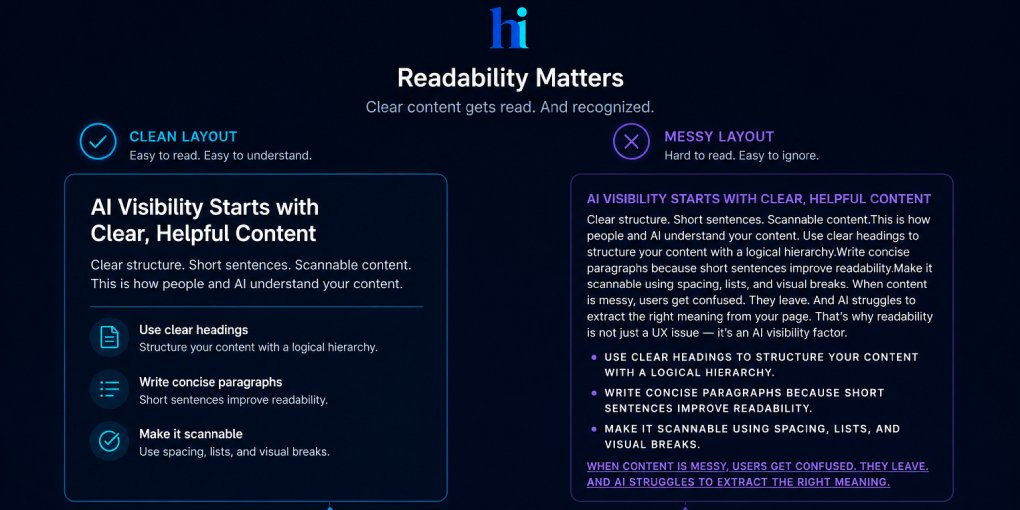
You can have perfect HTML structure, complete schema markup, and strong authority signals. But if your content is dense, convoluted, or poorly organized at the sentence level, LLMs will struggle to extract clean, quotable chunks from it. That’s what content clarity measures.
Content clarity defined
Content clarity is not about dumbing things down. It’s about precision. A clear page communicates its ideas efficiently, with sentences that don’t require re-reading, paragraphs that contain one idea each, and headings that appear frequently enough to create navigable sections.
In hey-eye’s scoring system, Content Clarity is one of four pillars, weighted at 15%. It’s the lowest-weighted pillar, but that doesn’t make it unimportant. A page with excellent structure and schema but terrible clarity still performs poorly, because the content that gets extracted is hard to use in a generated response.
What gets measured
Content clarity isn’t subjective. It’s based on quantifiable signals that correlate directly with extraction quality.
Flesch readability score. This classic formula measures how easy your text is to read based on sentence length and syllable count. Higher scores mean simpler, more accessible writing. LLMs don’t need simple text to understand it, but simpler text produces cleaner extractions. A sentence with three nested clauses might be grammatically correct, but when an LLM pulls it into a response, it reads awkwardly. A direct, clear sentence extracts and re-contextualizes cleanly.
Average sentence length. Long sentences create extraction problems. When a model quotes or paraphrases a 40-word sentence, it often has to truncate or restructure it, which reduces attribution accuracy. Sentences between 15 and 25 words extract most reliably. They’re long enough to carry a complete idea and short enough to stand alone in a generated response.
Heading density. This measures how frequently headings appear relative to your content length. A 2,000-word article with two headings has low heading density. The same article with eight headings has high density. Higher density means more chunk boundaries, which means the model can target specific sections rather than processing large undifferentiated blocks.
hey-eye also supports Greek language readability, applying adapted scoring formulas that account for the structural differences between Greek and English text.
Why clarity affects citation rates
LLMs don’t just extract content. They evaluate it for usability in a response. When a model assembles an answer from multiple sources, it prefers sources whose text can be dropped into the response with minimal reformulation.
Consider two pages that explain the same concept. Page A uses a 50-word sentence with technical jargon and multiple subordinate clauses. Page B states the same idea in 20 words, plainly. Both are accurate. But when the model needs to cite one, Page B wins every time because its text fits cleanly into a generated paragraph.
This is the hidden cost of unclear writing. Your content might be comprehensive and accurate, but if the model has to heavily rephrase it to make it fit a response, the attribution becomes weaker. The model might still use your idea but credit a clearer source that said the same thing more simply.
The readability trap
There’s a common misconception that readability optimization means writing for a low reading level. That’s not what content clarity is about. Academic papers can have high clarity if they use precise language and structured arguments. Marketing copy can have low clarity if it’s stuffed with buzzwords and run-on sentences.
Clarity is about how efficiently you communicate, not how simply. A technical article about API authentication can score high on clarity if each sentence makes one point, each paragraph covers one concept, and headings break the content into logical sections.
The question isn’t “would a child understand this?” It’s “could a machine extract any paragraph from this page and have it make sense on its own?”
Quick improvements
If your Content Clarity score is low, these fixes usually move the needle fastest:
Break long sentences. Find sentences over 30 words and split them. Every comma followed by “which,” “that,” “and,” or “but” is a potential split point. Two clear sentences beat one complex one.
Add subheadings. Aim for one heading every 200-300 words. If a section runs longer than that, find the natural break point and add an H2 or H3. This simultaneously improves heading density and extractability.
One idea per paragraph. Read each paragraph and ask: does this make one point or three? If it makes three, split it into three paragraphs. Short paragraphs aren’t lazy writing. They’re clear writing.
Lead with the point. Don’t build up to your conclusion within a paragraph. State the point in the first sentence, then support it. This front-loading pattern makes every paragraph independently extractable.
Measuring your clarity score
Run your page through hey-eye and check the Content Clarity pillar. The breakdown shows your Flesch score, average sentence length, and heading density individually, so you can see exactly which signal is pulling your score down.
Track improvements over time with Scan History. Clarity is one of the easiest pillars to improve because the fixes are mechanical: shorter sentences, more headings, tighter paragraphs. No new content needed. Just better packaging of what you already have.