Every piece of content that gets cited by an LLM started with a question someone actually asked. Not a keyword. Not a topic cluster. A real question from a real person looking for a real answer.
If you want LLMs to cite your content, you need to know what questions exist in your space, which ones are underserved, and how to answer them better than anything currently available. Here’s how to find them.
Why questions matter more than keywords
Traditional SEO starts with keywords. You find a high-volume term, write content around it, and optimize for rankings. That approach still works for Google, but LLMs operate differently.
When someone uses ChatGPT, Claude, or Gemini, they don’t type keywords. They ask questions. Full, natural-language questions like “how do I make my content visible to AI models” or “what’s the difference between structured data and schema markup.” The content that answers these questions directly and clearly is the content that gets extracted and cited.
This means your content strategy should start with questions, not keywords. The questions tell you what to write. The answers you provide determine whether LLMs surface your content.
Method 1: Google Search Console
Your existing Search Console data is a goldmine. Go to Performance > Queries and filter for queries that contain question words: “how,” “what,” “why,” “can,” “does,” “should.” These are the actual questions people typed into Google that led to impressions or clicks on your pages.
Sort by impressions rather than clicks. High-impression, low-click queries are questions where people are searching but not finding satisfying answers. That’s your opportunity.
Method 2: Google Autocomplete and People Also Ask
Start typing a question related to your topic in Google. The autocomplete suggestions show you the most common variations people search for. Write them down.
After you search, scroll to the “People Also Ask” section. Each question you click expands to reveal more related questions. This is an endless chain of real user queries organized by relevance.
The limitation: this is manual, slow, and hard to do systematically across many topics.
Method 3: Reddit and forums
Reddit is one of the most valuable sources for authentic questions. People don’t optimize their Reddit posts for SEO. They ask what they genuinely want to know, in their own words, with context that reveals their actual intent.
Search Reddit for your topic and look at the questions being asked. Pay attention to the upvoted answers too. If the top answer is incomplete or outdated, that’s a content gap you can fill.
The challenge: manually searching Reddit across multiple subreddits is time-consuming, and relevance varies widely.
Method 4: AI-powered question discovery
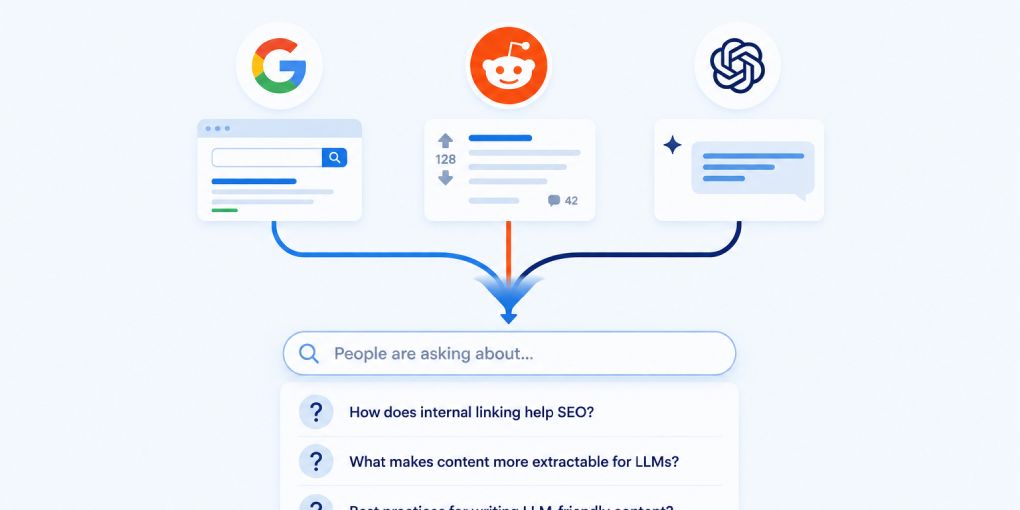
This is where automation changes the game. Instead of manually searching Google, Reddit, and forums one query at a time, you can use tools that aggregate questions from multiple sources, rank them by relevance, and surface the ones that matter most for your space.
We built Questions People Are Asking for exactly this purpose. Enter a topic or keyword and it pulls real questions from Google Suggest and Reddit discussions, ranks them by relevance to your subject, and presents the top results with context. You get a curated list of questions your audience is actually asking, without the manual research.
The advantage over manual methods is speed and coverage. In seconds you get questions from sources that would take hours to search individually. And because the results are ranked by relevance, you’re not wading through noise to find the signal.
Turning questions into extractable content
Finding questions is step one. Turning them into content that LLMs actually cite requires a specific approach:
Use the question as your H2. When someone asks an LLM the same question, your heading becomes a direct match. This dramatically increases extraction probability.
Answer in the first sentence. Don’t build up to the answer. State it immediately after the heading, then elaborate. LLMs weight the first sentence of each section heavily.
One question per section. Don’t bundle multiple questions under one heading. Each question deserves its own H2 with a clear, standalone answer.
Add FAQ schema. If your page answers multiple questions, wrap them in FAQPage JSON-LD. This gives LLMs structured, machine-readable access to your Q&A pairs.
The cycle that compounds
The best content strategies create a feedback loop: find questions, write answers, measure extractability with hey-eye, identify gaps, find more questions. Each cycle makes your content more comprehensive and more likely to be cited.
Start with the questions your audience is already asking. The answers you write today are the citations LLMs surface tomorrow.