When a large language model processes your page, it doesn’t read like a human. It chunks. It scans for structural signals that tell it where one idea ends and another begins. And the single most important signal for that process is your heading hierarchy.
Why headings matter more than you think
Search engines have used headings as ranking signals for years, but LLMs use them differently. Instead of just weighing keyword relevance, models like GPT, Claude, and Gemini treat headings as chunk boundaries. Each heading creates a new extractable unit of content.
Think of it this way: a page with no headings is a wall of text. An LLM can still process it, but it has no reliable way to isolate the specific paragraph that answers a user’s question. A page with clear H2 and H3 sections gives the model a table of contents it can navigate programmatically.
What “good” heading structure looks like
The rules are simpler than most people assume:
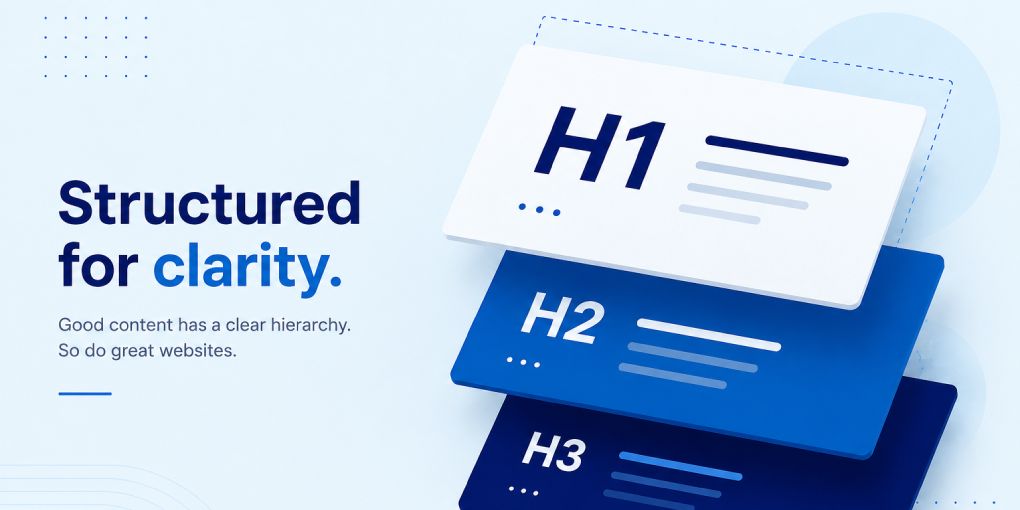
- One H1 per page. This is your topic declaration. It tells the LLM what this entire page is about. Multiple H1s create ambiguity.
- H2s for major sections. Each H2 should introduce a distinct subtopic. If someone asked “what does this page cover?”, your H2s should answer that question.
- H3s for supporting points. Use these to break down complex H2 sections. They help the model extract granular answers without losing context.
- No skipped levels. Jumping from H1 to H4 breaks the logical tree. LLMs interpret hierarchy literally, and a missing H2 signals incomplete structure.
The extraction penalty for flat content
When hey-eye analyzes a page, heading density and hierarchy are scored under the AI Extractability pillar (weighted at 35% of your total score). Pages with flat or missing heading structure consistently score lower, not because the content is bad, but because LLMs struggle to chunk it.
Here’s what we see in practice: a 2,000-word article with zero subheadings might score 40/100 on extractability. The same content reorganized under four H2 sections and two H3s per section can jump to 75+. The words didn’t change. The structure did.
A practical heading audit
Before you publish or update a page, run this quick check:
- Does the page have exactly one H1? If it has zero or more than one, fix that first.
- Do the H2s form a logical outline? Read just the H2s top to bottom. Does the sequence make sense on its own?
- Are H3s nested correctly? Every H3 should sit under an H2. If you have orphaned H3s, either promote them or group them.
- Is the heading density reasonable? Aim for one heading per 200-300 words. Fewer than that and sections become too long for clean extraction. More than that and headings lose their semantic weight.
What this means for your AI visibility score
Heading structure is one of the easiest wins in LLM optimization. Unlike building backlinks or earning author authority, restructuring headings is something you can do in an afternoon and see the impact immediately.
Run your page through hey-eye before and after restructuring. The extractability pillar will show you exactly which heading checks pass or fail, and the score difference will tell you how much the change mattered.
The models are reading your page right now. Make sure they can find what they’re looking for.