Internal linking is one of the oldest SEO tactics. Connect related pages, distribute authority, help users navigate. But in the context of LLM visibility, internal links play a different and arguably more important role: they help AI models map your content’s topical structure.
How LLMs use internal links
When an LLM processes a page, it doesn’t just read the text. It reads the signals around the text. Internal links are one of those signals. They tell the model that this page is connected to other pages on the same domain, covering related subtopics.
A page about “JSON-LD schema markup” that links to pages about “structured data testing,” “FAQ schema,” and “Article schema” sends a clear signal: this site has depth on structured data. That topical clustering makes the model more likely to treat your content as authoritative on the subject.
A standalone page with no internal links looks like an island. It might have great content, but the model has no way to verify that the site behind it has broader expertise.
Anchor text matters more than you think
The clickable text of your internal links acts as a label. When you link with descriptive anchor text like “learn how heading structure affects extractability,” you’re giving the LLM a summary of what the target page covers. That’s a free semantic hint.
Generic anchors like “click here” or “read more” waste that opportunity. The model gets a link but no context about what it leads to. Worse, it can’t use the link to understand the relationship between the two pages.
The hub-and-spoke pattern
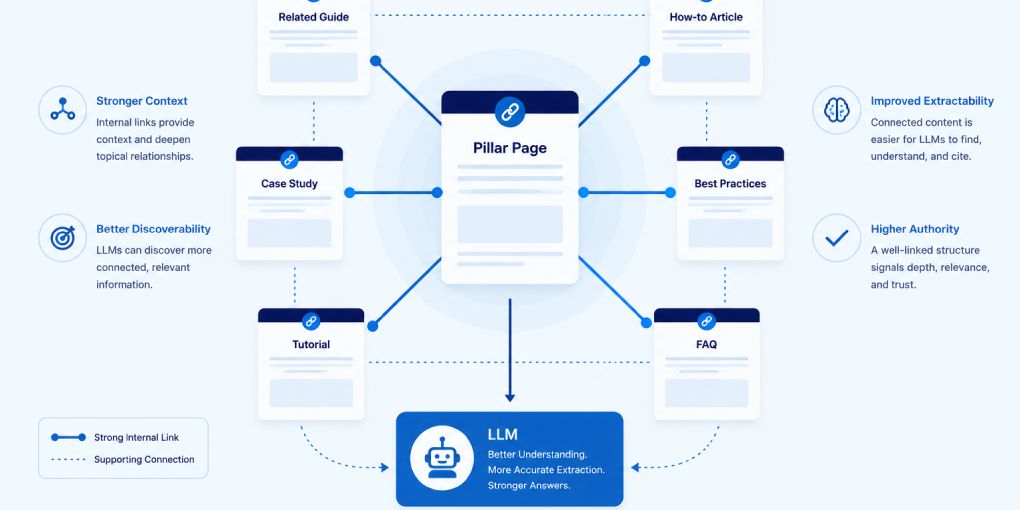
The most effective internal linking structure for LLM visibility follows a hub-and-spoke pattern. You have a central page (the hub) that covers a broad topic, and it links to multiple detailed pages (the spokes) that go deep on subtopics.
For example, a hub page about “AI visibility optimization” might link to spoke pages about heading structure, schema markup, meta descriptions, and robots.txt configuration. Each spoke links back to the hub.
This pattern does two things. First, it tells the LLM that your site has comprehensive coverage of the topic. Second, it creates multiple entry points. If the model extracts any one spoke, the internal links guide it to discover the rest.
What to avoid
Orphan pages. Any page with zero internal links pointing to it is invisible to both crawlers and LLMs navigating your site structure. Every piece of content should be reachable through at least two internal links.
Excessive linking. Linking every other sentence dilutes the signal. Each link should serve a purpose: either it helps the reader go deeper, or it establishes a topical connection. If it does neither, remove it.
Broken internal links. A 404 on an internal link is worse than no link at all. It signals poor maintenance, which models factor into trust assessment. Audit your internal links regularly.
Measuring the impact
Run a website audit across your sitemap and compare the AI extractability scores of well-linked pages versus orphan pages. The pattern is usually clear: pages with strong internal linking networks score higher on extractability, even when the content quality is similar.
Internal links are not glamorous. They don’t make headlines in SEO discussions anymore. But for LLM visibility, they remain one of the simplest ways to signal depth, connect context, and improve your chances of being extracted and cited.