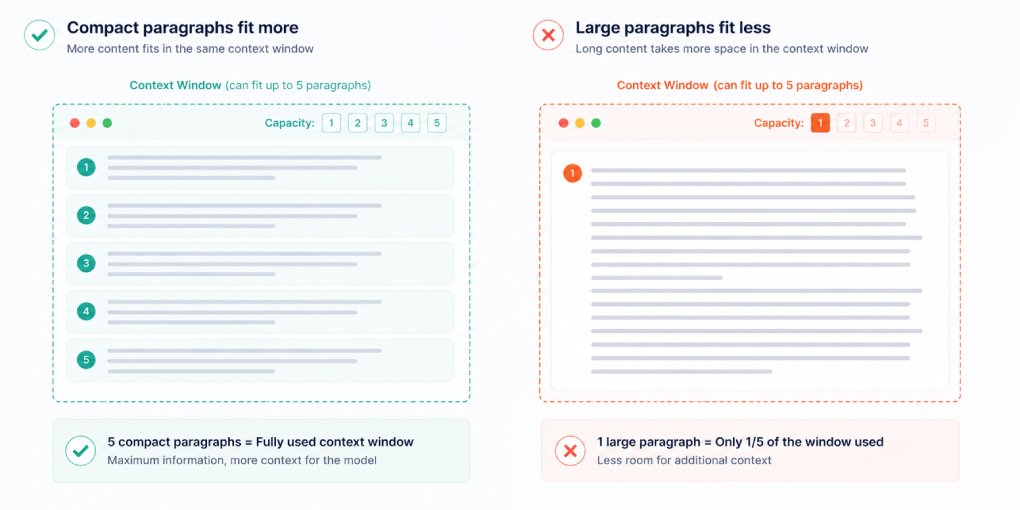
Every LLM has a context window: a fixed amount of text it can process at once. When your page enters that window alongside other sources, every paragraph competes for space. Long, rambling paragraphs waste context. Short, self-contained paragraphs maximize the chance that your content survives the cut.
Understanding how context windows work changes how you write paragraphs.
What a context window is
A context window is the total amount of text an LLM can hold in memory during a single interaction. It includes the user’s question, the system prompt, retrieved content from multiple sources, and the model’s own response. Everything has to fit.
When a model retrieves your page to answer a question, it doesn’t process the entire page. It selects the most relevant chunks: sections under specific headings, individual paragraphs, or structured data blocks. Each chunk occupies space in the context window. Space that could go to your content or to a competitor’s.
This is why paragraph optimization matters. A 200-word paragraph that contains one relevant sentence and seven sentences of context wastes 90% of the space it occupies. A 50-word paragraph that makes one clear, complete point uses its space efficiently.
How chunking works
LLMs don’t read your page top to bottom like a human. They chunk it. The chunking process breaks your content into segments, typically at heading boundaries, paragraph breaks, or list boundaries.
Each chunk gets evaluated independently for relevance to the user’s query. Relevant chunks get pulled into the context window. Irrelevant chunks get discarded.
This means every paragraph is a potential extraction unit. When a model evaluates your paragraph, it asks: does this chunk answer or contribute to the user’s question? If yes, it enters the context window. If no, it’s skipped.
The implication is direct: every paragraph should be a self-contained unit that makes sense without the paragraphs before or after it. Because in the context window, those surrounding paragraphs might not be there.
The ideal paragraph for LLM extraction
40-80 words. Short enough to be processed as a single chunk. Long enough to carry a complete idea. Research on AI extractability consistently shows this range produces the highest citation rates.
One idea per paragraph. A paragraph that covers setup instructions, pricing, and troubleshooting is three chunks masquerading as one. The model can’t extract the pricing information without taking the setup and troubleshooting content along with it. Split them.
Front-loaded main point. State the key information in the first sentence. If the model truncates the paragraph (which happens when context is tight), the first sentence survives. “JSON-LD schema improves AI extractability by 10-15 points on average” is a strong opener. “There are many factors to consider when thinking about schema implementation” is not.
Named subjects, not pronouns. “It improves performance significantly” requires the previous paragraph for context. “JSON-LD schema improves AI Extractability scores by an average of 10-15 points” stands alone. In a context window, standing alone is everything.
Specific claims, not vague qualifiers. “Many websites have this problem” wastes context space on a statement that says nothing. “68% of websites lack JSON-LD schema on their content pages” is a fact that a model can cite.
What happens to long paragraphs
When a paragraph exceeds 150 words, three things can happen in a model’s processing pipeline:
Truncation. The model cuts the paragraph to fit available context space. The beginning survives, the end is lost. If your key point was in the fourth sentence, it never reaches the response.
Summarization. The model condenses the paragraph into a shorter representation. Your specific claims become generalized statements. “68% of websites lack schema” becomes “many websites lack schema.” You lose precision and the model loses confidence in attribution.
Skipping. If the paragraph is too long and only partially relevant, the model might skip it entirely and pull a shorter, cleaner paragraph from a competing source. The competitor’s content wins not because it’s better, but because it’s more efficiently structured.
None of these outcomes are good. All of them are avoidable by writing shorter paragraphs.
Paragraph patterns that extract well
Some paragraph structures consistently perform better in AI extraction:
Definition pattern. “AI extractability is the measure of how easily language models can find, isolate, and cite specific content from a web page.” One sentence, one concept, completely self-contained. The most reliably extracted pattern.
Claim + evidence. “Pages with FAQ schema receive 3x more AI citations than pages without it. This is because FAQ schema provides pre-structured Q&A pairs that models can extract without any reformulation.” Two sentences, one claim with supporting data.
Instruction. “Add a <script type='application/ld+json'> block to your page’s head section containing your Article schema with headline, author, datePublished, and description fields.” Complete action in one paragraph. Nothing left implied.
Comparison. “Unlike traditional SEO which optimizes for ranking position, GEO optimizes for citation inclusion. A page can rank #1 in Google but never appear in an AI-generated response if its content isn’t structured for extraction.” Clear contrast, two sentences, standalone meaning.
How to audit your paragraphs
Open your most important page and scan each paragraph:
-
Count the words. Any paragraph over 100 words is a candidate for splitting. Over 150 is almost certainly too long for clean extraction.
-
Check the first sentence. Does it state the paragraph’s main point? If you read only the first sentence of each paragraph on the page, do you get the complete argument?
-
Test independence. Pick any paragraph at random. Read it without reading the one before or after. Does it make complete sense? If it starts with “However,” “Additionally,” “This means,” or “As mentioned,” it depends on context that might not be present in the context window.
-
Count the ideas. Does the paragraph make one point or three? If three, split it into three paragraphs.
-
Check for specifics. Does every claim include a specific number, name, or reference? Replace every “many,” “significant,” and “recently” with actual data.
Measuring the impact
After restructuring your paragraphs, run the page through hey-eye. The Content Clarity pillar specifically measures paragraph length distribution and readability, while the AI Extractability pillar evaluates whether your content structure supports clean chunk-based extraction.
Compare your before and after scores. Paragraph optimization typically improves both pillars simultaneously because shorter, clearer paragraphs are both more readable and more extractable.
The context window is finite. Make every paragraph earn its place in it.