Bing Webmaster Tools now has two reports side by side.
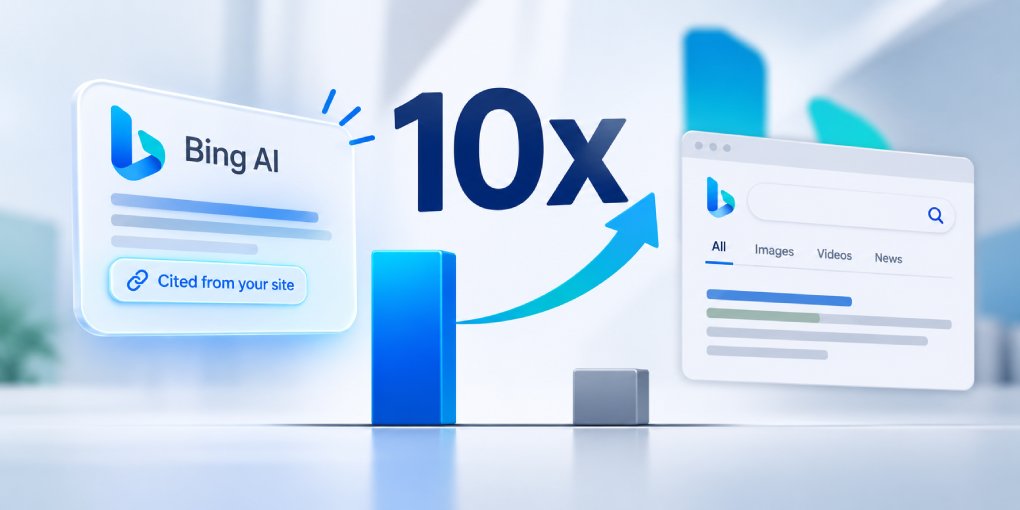
One shows how often your site appears in Bing search results. The other shows how often your pages are cited as a source in AI-generated answers.
I exported both for hey-eye, covering the same 91 days, and put them next to each other.
They don’t describe the same website.
The numbers
Period: August 3 to November 1, 2026. Same site, same 91 days.
| Bing AI | Bing Search | |
|---|---|---|
| Total | 1,441 citations | 9.5x fewer impressions |
| Days with activity | 82 of 91 | 65 of 91 |
| Busiest day | 62 citations | single digits |
On 81 of 91 days, the site was cited in AI answers more often than it was shown in search results.
If you add the two together, 90% of my site’s visibility on Bing came from AI answers. Ten percent came from the classic list of blue links.
Month by month
| Month | AI citations | Ratio to search impressions |
|---|---|---|
| August | 457 | 12x |
| September | 538 | 13.5x |
| October | 438 | 6x |
October is the interesting one. Search impressions grew by about 75% that month, while citations dipped by about a fifth. The gap narrowed, but AI was still six times larger.
The citations come from a handful of pages
On any given day, between 1 and 6 pages were cited, with an average of under 3. The same few pages do almost all of the work.
This matches what I found earlier this year: a small group of articles from one topic cluster accounted for nearly all citations, while the pages I considered most important barely appeared.
How this compares with Google
Google’s Search Console has its own AI report, which counts impressions where a link to your site appeared inside AI Overviews or AI Mode.
For the same site, over the same period, AI features account for roughly a quarter of Google impressions. The rest is classic search.
| Share of visibility from AI | |
|---|---|
| Google (AI Overviews and AI Mode) | ~26% |
| Bing (AI citations vs search impressions) | ~90% |
The two reports measure slightly different things, citations on one side and impressions on the other, so treat this as a direction rather than an exact comparison. But the direction is hard to miss. On Google, AI is a growing slice of visibility. On Bing, for a site like mine, it is almost all of it.
Why does this happen?
Nobody outside Microsoft can see how answers are assembled. But the pattern has a few plausible explanations, and they reinforce each other.
1. One question can trigger many searches. When someone asks an AI assistant a complex question, the system typically breaks it into several smaller searches behind the scenes and pulls sources for each. A single human question can therefore produce several citations. A single human search produces at most one impression per result.
2. AI answers go deeper than a human does. A person rarely scrolls past the first few results. A retrieval system can pull a passage from a page that ranks well below the top, if that passage answers one specific part of the question. A small site without much authority can lose the ranking and still win the citation.
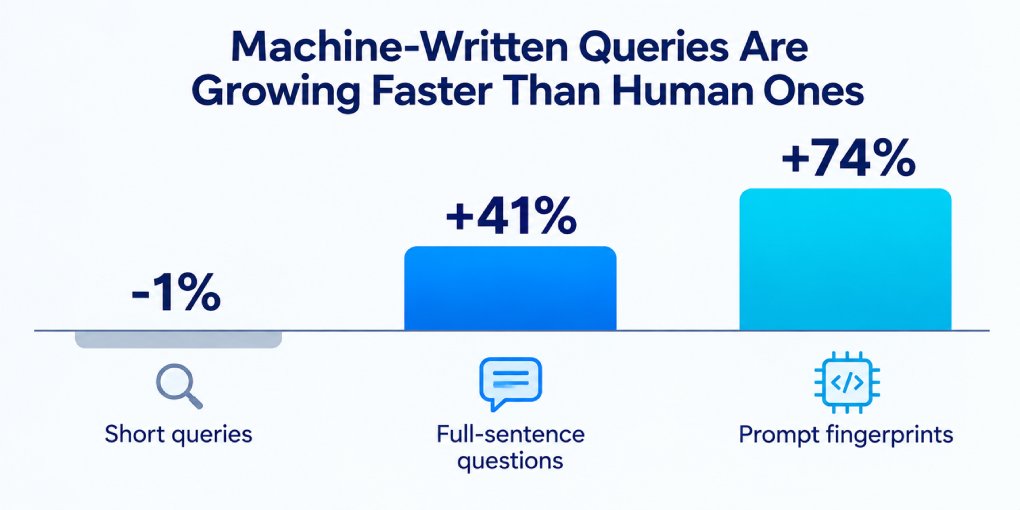
3. AI questions are longer and more specific. Search queries are short: “llms.txt”, “AI crawler test”. The questions people ask an assistant are full sentences about a precise problem. Narrow, specific content matches narrow, specific questions better than it matches short keywords where large sites dominate.
4. Structure makes a page easy to quote. The pages that get cited have clear definitions, short self-contained sections and headings that state what each section answers. Those are the exact properties that make a passage easy for a model to extract and attribute. More on why structure matters for retrieval.
What the numbers don’t tell you
This is where I have to be careful, because I’ve misread this report before.
A citation is not a visit. Over the same 91 days, Bing search sent a handful of clicks. The AI report shows no clicks at all. Being cited does not mean anyone read the page, or even saw the link.
The report has a history of corrections. Earlier this year, a sudden jump in this report turned out to be a data backfill by Microsoft, not real growth. I wrote that up honestly at the time, in Is AI Visibility Real?. Then the report went to zero for weeks before data returned in August. The current numbers may be revised again.
The scale is small. This is one site, with one topic, over three months. It shows a pattern, not a law.
What I take from it
Ranking and being cited are now two different games. A page can be nearly invisible in search and still be one of the sources an AI system quotes most. If you only track rankings, you are missing most of what happens to a site like this on Bing.
Measure both, separately. Search impressions tell you what humans saw. Citations tell you what machines used. Adding them together, or reading one as a proxy for the other, hides the real picture.
Don’t confuse citations with traffic. Being the source of an answer has value for credibility and brand. It rarely sends visitors. Plan for that, rather than hoping citations will turn into clicks.
Write for the specific question, not the short keyword. On a small site, competing for “llms.txt” against large brands is a losing battle. Answering “how do I check whether ClaudeBot can reach my blog behind Cloudflare” is not.
Check your own site
In Bing Webmaster Tools, export both the Search Performance report and the AI Performance report for the same date range. Compare totals, then compare day by day. If citations are larger than impressions most days, your site’s real audience on Bing is no longer the person typing in the search box.
To see whether your pages are structured in a way AI systems can extract and cite, run them through hey-eye.