A few weeks ago I wrote about the prompts showing up in my Search Console: full questions, line breaks nobody can type, leftover system instructions.
Then I exported the same report again, one month later.
The human queries had barely moved. The machine-written ones had not stopped growing.
How I measured
I compared two Search Console query exports for hey-eye, each covering the previous three months, taken one month apart (October 2 and November 3, 2026). The windows overlap, so the change reflects what the newest month added and the oldest month dropped.
Every query was sorted into one of three groups:
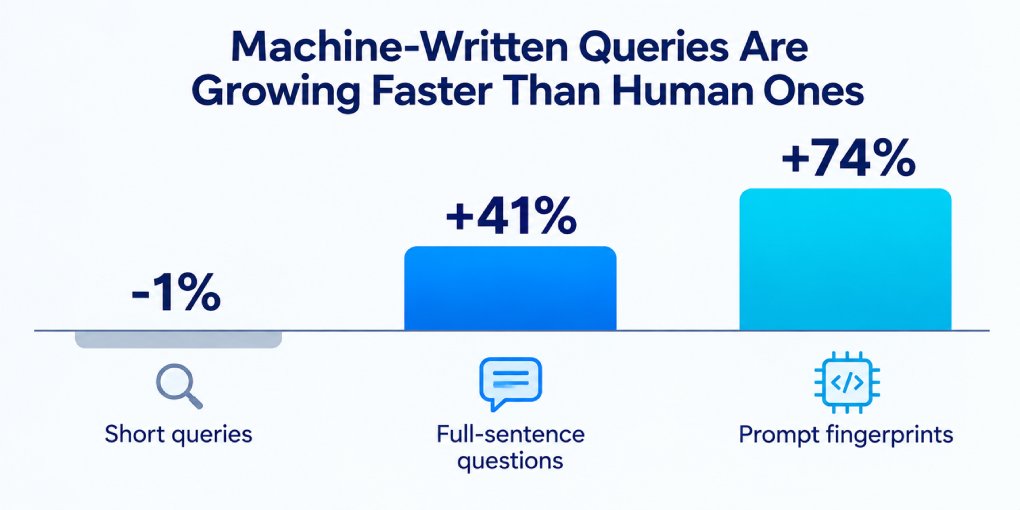
- Short queries. Fewer than seven words, no question mark. The way people type: “llms.txt generator”, “ai crawler test”.
- Full-sentence questions. Seven words or more, or ending in a question mark. Mostly machine-generated, though some are typed by people.
- Queries with prompt fingerprints. Line breaks inside the query, system instructions like “context:” or “question:”, or search operators chained together. These cannot come from a person typing into a search box.
One note on method: between the two exports, Google renamed the search type filter from “Web” to “Web (text-based)”. That may shift totals slightly. It does not explain the differences below.
The numbers
| Query type | Change in distinct queries | Change in impressions | Avg. position | Clicks |
|---|---|---|---|---|
| Short queries | -1% | +29% | 40.5 | all of them |
| Full-sentence questions | +41% | +17% | 6.2 | zero |
| Prompt fingerprints | +74% | +69% | 13.7 | zero |
Human-style queries were flat. Almost exactly the same number of distinct short queries in both exports.
Machine-style queries were not. Full-sentence questions grew by 41%. Queries carrying obvious prompt fingerprints grew by 74%.
As a share of all distinct queries the site appeared for, machine-style queries went from 34% to 43% in one month.
And the pattern from before held completely: every single click came from short queries. The full-sentence questions sit on page one, at an average position of 6.2, and produce nothing.
What the machines are asking now
The growth wasn’t just more of the same. The questions changed.
1. A shift from content to agents
A month ago, most machine questions were about content: how to make a page extractable, how to get cited.
The new ones are about AI agents themselves:
how do businesses know if an ai agent is following the user instructions?
how can i audit where an ai agent got its information about a customer?
how do you trace ai agent actions back to users?
best tools to detect automated ai agents scraping or abusing our platform
That is a different buyer. Not a marketer asking about visibility, but someone responsible for security, compliance or operations asking how to control agents.
2. Head-to-head comparison templates
This one surprised me most. The same sentence kept appearing with different product names swapped in:
i’m trying to understand how ai agents are crawling and interpreting my website. which is better for my specific needs, [tool A] or [tool B]? provide a definitive answer
Same wording, five different pairs of AI visibility vendors. That is not a person. That is a prompt set comparing vendors to each other, run on a schedule, and my site was surfacing in the results for it.
3. Corporate framing
our board keeps asking about our visibility in ai search results and i have no idea how to measure or report on that
i work at a company with 250-1k employees. how do you compare data extraction tools?
Company size, internal pressure, reporting needs. These read like synthetic buyer personas designed to represent a specific market segment.
4. More languages
Spanish, German and Italian versions of the same intent, phrased natively:
come posso verificare se il mio sito web è configurato correttamente per la ricerca ia?
Where do these queries come from?
Search Console only records that a query was searched on Google and that your page appeared. It does not say who sent it. But the evidence points in a clear direction:
- Line breaks and system instructions mean the text was generated or pasted by software, not typed.
- Identical templates with swapped names mean someone is running the same prompt across many variations.
- Personas and company sizes are the standard way AI visibility tracking tools segment their prompt sets.
The most likely sources are AI visibility trackers that test prompts against Google, and AI systems that search the web on a user’s behalf. I can’t prove which one sent which query. The pattern is consistent with both, and with their combined growth.
Why this matters
Your query report is turning into a dataset of what machines ask about your market. That is not noise to filter out. It is a live view of which questions automated systems consider important in your space, which buyer roles they simulate, and which competitors they compare.
CTR is becoming meaningless as a single number. When almost half of your distinct queries can never produce a click, a site-wide click-through rate blends two populations that behave completely differently. Measure them separately.
Position is lying to you, politely. An average position of 6 looks like page-one success. For these queries, it describes a place where no person was ever looking.
The topics machines ask about move fast. In one month, the focus shifted from content visibility to agent monitoring. If your content strategy is built on last quarter’s keyword research, the machine side of your audience has already moved on.
How to do this on your own site
- Export the Queries table from Search Console for the last three months. Do it again one month later.
- Split each export into short queries, full-sentence questions, and queries with line breaks or instruction text.
- Compare the count of distinct queries in each group, not just impressions.
- Read the machine queries as research: which roles, company sizes, competitors and languages appear?
- Check clicks per group. If the machine groups show zero, stop judging your snippets by their CTR.
If you want to see how well your pages answer the kind of specific question these systems ask, run them through hey-eye.