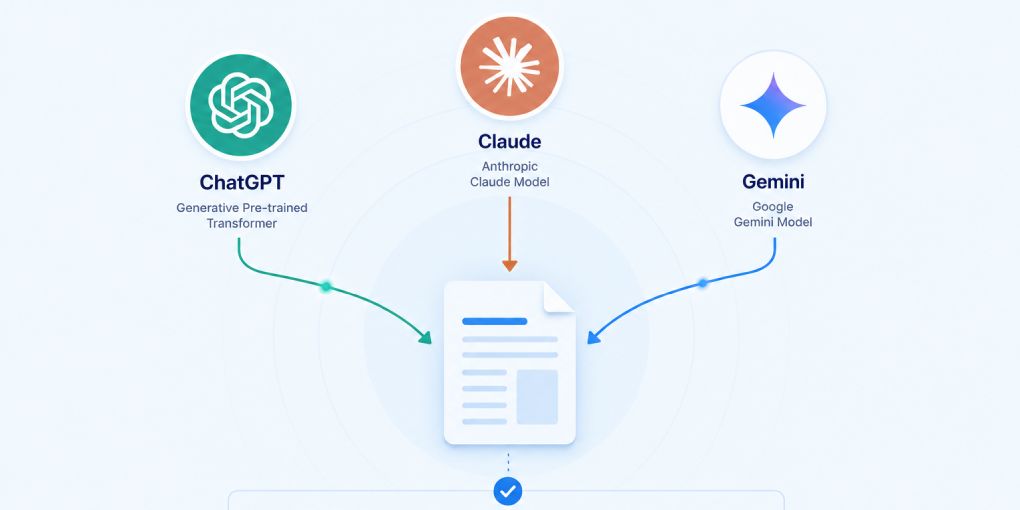
It’s a fair question. GPT, Claude, and Gemini are different models built by different companies with different training data and retrieval approaches. If they process content differently, shouldn’t you optimize for each one separately?
The short answer: no. And here’s why.
The models agree on structure
Despite their differences in reasoning, tone, and output style, all major LLMs share the same fundamental needs when extracting content from a webpage. They all look for clear headings, well-structured HTML, schema markup, short paragraphs, and definitional statements they can quote.
No model prefers messy HTML. No model extracts better from a page without headings. No model ignores JSON-LD schema. The structural foundations of extractability are universal.
Where models differ is in how they rank and weight sources, how they handle ambiguity, and how they phrase their responses. Those are output differences, not input requirements. You can’t control how a model phrases its answer, but you can control how easy you make it for any model to find and extract yours.
The risk of model-specific optimization
Some SEO practitioners have started testing tactics that target specific models. Phrasing content in ways that match GPT’s preferred citation patterns, for instance, or structuring answers to match how Gemini summarizes.
This approach has two problems. First, the models update constantly. A pattern that works for GPT-4o today might not work for the next version. You’d be chasing a moving target with each model release.
Second, optimizing for one model often means making tradeoffs that hurt performance on others. If you structure content to match how Claude chunks information but that structure is unusual for Gemini’s parser, you’ve gained on one front and lost on another.
What actually moves the needle
The factors that consistently improve visibility across all models are the same factors that make content better for humans:
Semantic HTML. Proper heading hierarchy, paragraph tags, lists where appropriate. This is the foundation.
Structured data. JSON-LD schema (Article, FAQPage, HowTo) gives every model explicit metadata to work with. No model ignores it.
Clear definitions. When you define a concept, state it plainly. “X is…” patterns are universally extractable.
Trust signals. Author attribution, About pages, external citations to authoritative sources. Every model uses some form of source quality assessment.
Crawlability. If AI bots can’t access your page (blocked in robots.txt, behind a login wall, rendered entirely in JavaScript), no optimization matters.
When model-specific thinking helps
There is one scenario where thinking about specific models matters: testing. After you’ve implemented general best practices, it’s worth asking each major model questions that should surface your content. If ChatGPT cites you but Claude doesn’t, that gap might reveal a specific structural issue worth investigating.
But the fix is almost never model-specific. Usually it’s a general improvement (better schema, clearer headings, stronger opening paragraph) that happens to cross a threshold for that particular model.
The practical approach
Optimize once, optimize well, optimize for structure. Run your pages through hey-eye and focus on the four pillars: Structural Integrity, AI Extractability, Content Clarity, and Authority & Trust. A page that scores well across all four will perform well across all models.
The best strategy for LLM visibility isn’t knowing how each model works internally. It’s making your content so well-structured that any model can extract it effortlessly.