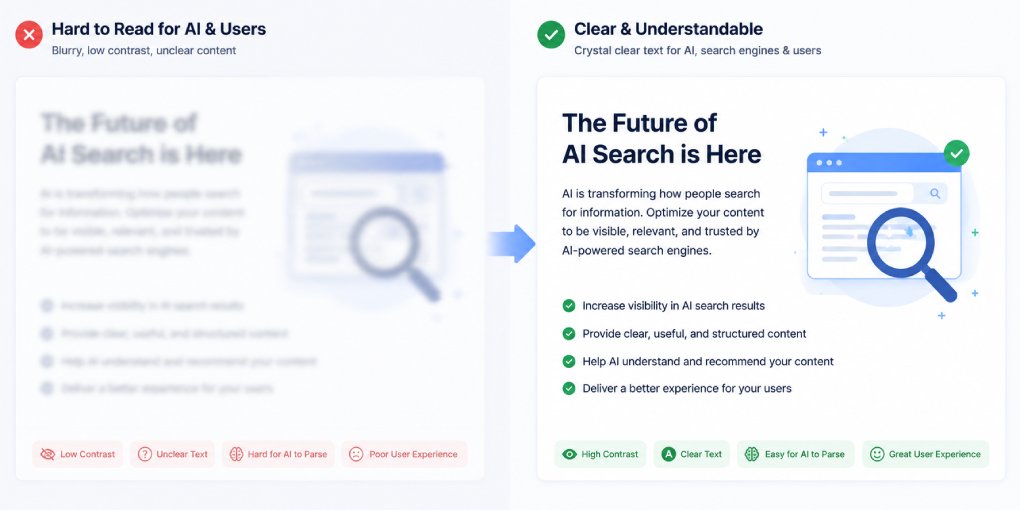
An LLM won’t cite content it isn’t sure about. When your page contains vague statements, undefined terms, or sentences that could mean two different things, the model faces a choice: guess what you meant, or move on to a page where the meaning is clear.
Models move on. Every time.
Ambiguity is the invisible extractability killer. Your structure might be perfect. Your schema might be complete. But if the content itself is unclear, models can’t confidently extract it, attribute it, or present it to users. Here’s how to fix that.
What ambiguity looks like to an LLM
Humans resolve ambiguity using context, experience, and common sense. LLMs can do this too, but they do it less reliably, and when they’re choosing between sources to cite, they prefer the source that doesn’t require interpretation.
Pronoun ambiguity. “The tool analyzes the page and then it generates a report.” What does “it” refer to? The tool or the page? A human figures it out instantly. An LLM processes it as genuinely ambiguous, which reduces extraction confidence.
Undefined jargon. “Improve your E-E-A-T signals to boost extractability.” If the page never defines E-E-A-T, the model can’t verify whether the statement is accurate in context. It might know what E-E-A-T means from training data, but it can’t confirm your usage matches the standard definition.
Relative statements. “This approach is significantly better.” Better than what? Better how? Better for whom? Relative claims without a reference point are meaningless to a model trying to extract factual statements.
Implied context. “As we discussed earlier, the third option is clearly the best choice.” An LLM processing this paragraph in isolation has no idea what the three options are, what was discussed earlier, or why the third one is best. The sentence is only meaningful with surrounding context, which makes it a poor extraction candidate.
The cost of ambiguity
Ambiguity doesn’t just reduce citation likelihood. It introduces a more dangerous problem: misattribution. When a model extracts an ambiguous statement and fills in the gaps with its own interpretation, the resulting citation might misrepresent what you actually said.
“Our platform handles this automatically” could be cited in a context where “this” refers to something you never meant. The model interpreted the ambiguity, got it wrong, and attributed the wrong meaning to your page.
Clear content gives models no room to misinterpret. Every statement means exactly one thing. Every claim is specific. Every reference is explicit.
How to eliminate ambiguity
Replace pronouns with nouns. Instead of “it processes the data and returns it,” write “the analyzer processes the HTML and returns a visibility score.” More words, but zero ambiguity. LLMs extract the second version confidently because every entity is named.
Define terms on first use. When you introduce a concept, define it immediately. “AI extractability measures how easily language models can find, isolate, and cite specific content from your page.” Now every subsequent use of “extractability” on the page has a clear reference point.
Use specific numbers instead of qualifiers. Instead of “significantly faster,” write “40% faster.” Instead of “many websites,” write “68% of websites.” Instead of “recently updated,” write “updated June 2026.” Specific claims extract cleanly. Vague qualifiers don’t.
Name the comparison. Instead of “our tool is more accurate,” write “hey-eye’s analysis covers 47 individual checks compared to the typical 15-20 in other tools.” The comparison is explicit. The model can extract this as a factual statement, not an opinion.
Eliminate “this” and “that” at the start of sentences. “This is important because…” What is important? Rewrite as “Schema markup is important because…” Name the subject every time.
Avoid conditional ambiguity. “If you implement these changes, you might see improvements.” Which changes? What kind of improvements? How much? Rewrite as “Adding JSON-LD schema typically improves AI Extractability scores by 10-15 points within one crawl cycle.”
Structural ambiguity
Ambiguity isn’t only in the words. Page structure can create confusion too.
Headings that don’t match content. An H2 that says “Getting Started” followed by three paragraphs about pricing creates a structural mismatch. The model uses headings to understand what each section covers. When the heading promises one topic and the content delivers another, extraction quality drops.
Sections that blend together. Two topics discussed in the same section without a heading break appear as one topic to the model. If your page covers both “implementation” and “troubleshooting” under a single H2, the model can’t separate the advice it extracts. Add a heading for each distinct topic.
Lists without context. A bulleted list that starts without an introductory sentence leaves the model guessing what the list represents. Always introduce a list with a sentence that explains what the items are: “The four pillars of AI visibility are:” followed by the list.
Orphaned paragraphs. A paragraph between two sections that doesn’t clearly belong to either creates ambiguity about its context. Every paragraph should sit under a heading that accurately describes its topic.
The clarity test
Before publishing, run this test on each section of your content:
-
Pull any paragraph out of context. Does it make sense on its own? If it depends on the previous paragraph to be understood, it’s not independently extractable.
-
Read only the headings. Do they form a logical outline? Could someone understand the page’s structure from headings alone?
-
Search for “this,” “that,” “it,” “these,” and “those.” For each one, check whether the reference is immediately clear. If you have to re-read the previous sentence to know what “this” refers to, rewrite it.
-
Search for qualifiers without numbers. “Many,” “most,” “significant,” “several,” “recently.” Can any of these be replaced with specific figures?
-
Check heading-content alignment. Does each section deliver what its heading promises? Nothing more, nothing less.
Measuring the improvement
After reducing ambiguity, run your page through hey-eye and check the Content Clarity and AI Extractability pillars. Clearer content typically improves both simultaneously because the same qualities that reduce ambiguity (specific language, explicit definitions, named entities) also improve readability scores and extraction quality.
Compare your before and after scores with the Compare tool by saving your original page and measuring against the revised version. The score difference tells you exactly how much your clarity improvements affected machine readability.
Ambiguity is fixable. It doesn’t require new content or new ideas. It requires going through what you’ve already written and making every sentence say exactly one thing, clearly, completely, and unmistakably.