I build a tool that measures how AI systems read websites.
So it would be strange not to point the same questions at my own site.
I pulled seven months of Search Console data for hey-eye, merged every export into one weekly timeline, and split it every way I could think of. Here is what it shows, including the parts that are not flattering.
Impressions grew. Clicks did not follow.
Between June and September, weekly impressions roughly tripled.
Clicks stayed flat. Same range every week, July to the end of September.
Overall click-through rate across the last three months: 0.46%.
On its own, that looks like a snippet problem. Weak titles, boring descriptions, fix the meta tags. I spent weeks believing exactly that.
It was not a snippet problem. It was an audience problem.
Half the “searchers” read like prompts
I split every query I could see into two groups.
Short, fragmentary queries. The way people type. “extractability score”. “hey eye”. “content clarity meaning”.
Full-sentence questions. Grammatical, complete, often with a question mark.
The split:
| Query type | Share of visible impressions | Average position | Share of clicks |
|---|---|---|---|
| Short queries | 54% | 40 | 100% |
| Full-sentence questions | 46% | 6.7 | 0% |
Read that again. The full-sentence group ranks at an average position of 6.7, on page one, and has never produced a single click.
Some full questions are typed by real people. Not all of them. But a meaningful slice cannot be human, because they contain literal newline characters, which you cannot type into a search box, or leftover prompt scaffolding like this:
context: location: united states (not for language). do not include location references in your response. question: how do i measure ai brand visibility lift after publishing new content
That is a system instruction wrapped around a question. I wrote about finding the first of these a few weeks ago. Since then, the number of prompt-shaped queries hitting the site grew by roughly a quarter in three weeks.
The new part: the prompts now have personas
This is what I did not see last time.
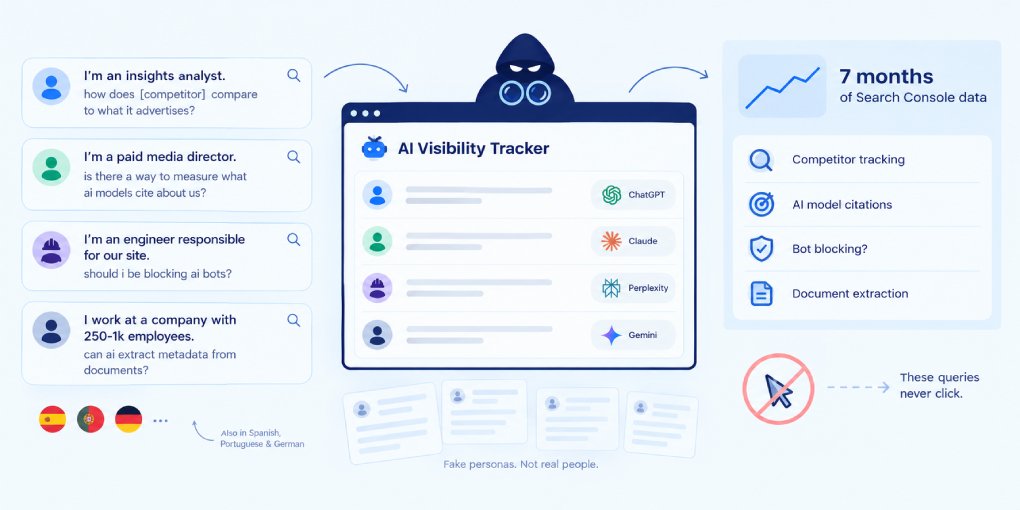
The machine queries are no longer generic. They come with a role attached:
i’m an insights analyst. how does [a competing tool]‘s actual coverage of ai models compare to what it advertises?
as a data analyst, can you actually measure how often a brand appears in ai chatbot answers, and how?
i’m a paid media director. is there a way to measure whether our earned media is what ai models cite about our candidate?
i work at a company with 250-1k employees. can ai extract metadata from documents?
And they arrive in Spanish, Portuguese and German, phrased natively rather than translated word for word.
Persona, company size, language, market. That is the exact shape of a prompt set built to track AI visibility at scale: generate the same intent across many audience profiles, run them on a schedule, record who gets cited.
I cannot prove which tools send them. It is an inference from the pattern. But it means something slightly absurd: a meaningful part of the “search demand” for an AI visibility site is other AI visibility tools, measuring each other.
If you sell into a niche like this one, your impression numbers are partly a census of your competitors’ monitoring.
Pages that AI features love get the fewest clicks
Search Console’s Generative AI report shows which impressions came with your link inside AI Overviews or AI Mode. Across the site, that share swung between 10% and 32% from week to week.
I grouped every page by how much of its visibility came from those AI surfaces:
| AI feature share of a page’s impressions | Share of site impressions | Share of site clicks | CTR vs site average |
|---|---|---|---|
| 40% or more | 15% | 4% | about 3x lower |
| 15% to 40% | 40% | 51% | slightly higher |
| Under 15% | 44% | 43% | about average |
The pages in the top group are not badly ranked. They sit between positions 2 and 9. They are mostly the definitional pages: what AI extractability is, what structural integrity means, how an extractability score works.
Which makes sense when you think about it. A definition is exactly what an AI Overview can answer completely. Once the answer is on the results page, the click has no reason to happen.
One caveat I want to be explicit about: this is a correlation on a small site. It is consistent with AI answers absorbing clicks on definitional content. It does not prove it. The Generative AI report also undercounts, so the real AI share is likely higher everywhere.
What actually gets clicked
Nearly half of all clicks came from just four pages.
One is the homepage, almost entirely branded searches. The other three have something in common:
- How to detect AI agents on your website
- How to check if a website is ready for AI agents
- Article vs BlogPosting schema, which also climbed six positions in the last few weeks
None of them is a definition. All of them are something you do. You land, you follow steps, you leave with a working result.
That pattern has held since I started tracking. Execution intent gets the clicks. Explanation intent gets the AI Overview.
One article behaved differently
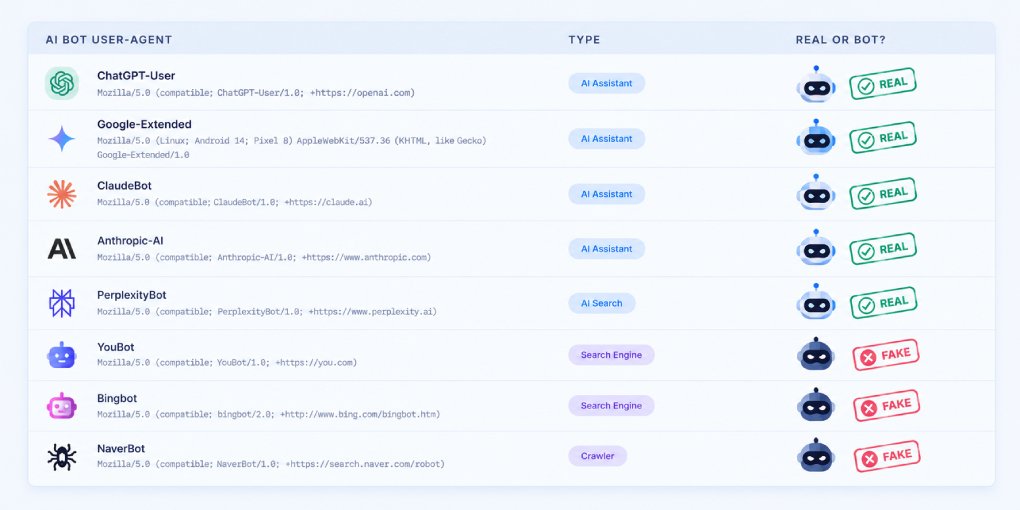
Two weeks ago I published an analysis of spoofed AI crawler traffic, built entirely from my own bot logs.
So far it is the most AI-surfaced page on the site: 80% of its impressions came through AI features, far above anything else.
Within two weeks it was ranking in the top six for questions that are near paraphrases of its own subject, including position 1 for “how do i verify that an ai crawler is genuine and not a spoofed user agent?”
It is early and the sample is small. But it is the first page on the site that was picked up this fast, and it is also the first one made entirely from data nobody else had.
I do not think that is a coincidence. A generic how-to competes with a thousand similar pages. A dataset only exists in one place, so a system looking for a source for that claim has one candidate.
What I changed because of this
I stopped writing explainers. The site has plenty of definitional content already, and the data says AI surfaces will answer those questions without sending anyone. Each new one adds impressions and very little else.
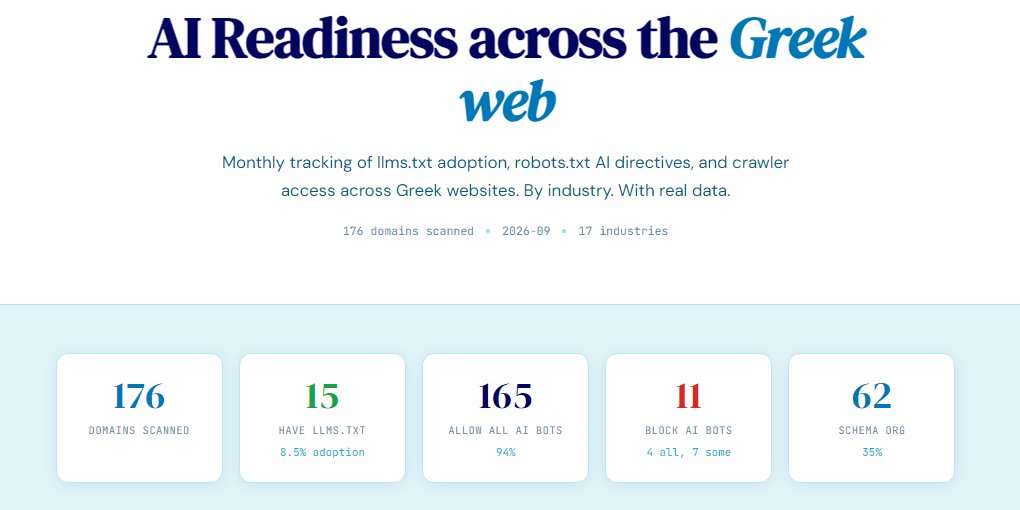
I write from primary data only. Bot logs, crawls, scans, my own analytics. If the numbers do not exist anywhere else, the article is worth writing. The scan of 176 Greek websites came out of that decision.
I read CTR per query type, never in aggregate. A site-wide click-through rate that blends humans with machine prompts describes nobody. Separate them first, then judge your snippets.
I treat machine queries as a signal, not noise. They will never click. But they show which questions are being asked about your topic at scale, in which languages, by which kind of buyer. That is better audience research than most keyword tools give you.
How to run this on your own site
- Export the Queries tab from Search Console for the last three months.
- Mark every query that is a full sentence, contains a newline, or contains words like “context:”, “question:” or a persona (“i’m a…”, “as a…”).
- Compare impressions, position and clicks for the two groups separately.
- Export the Generative AI features report and divide each page’s AI impressions by its total impressions.
- Group pages by that share and compare click-through rates.
If your numbers look like mine, your snippets are probably fine. Your audience just is not entirely human anymore.
To check how your own pages are structured for the AI systems reading them, run them through hey-eye.