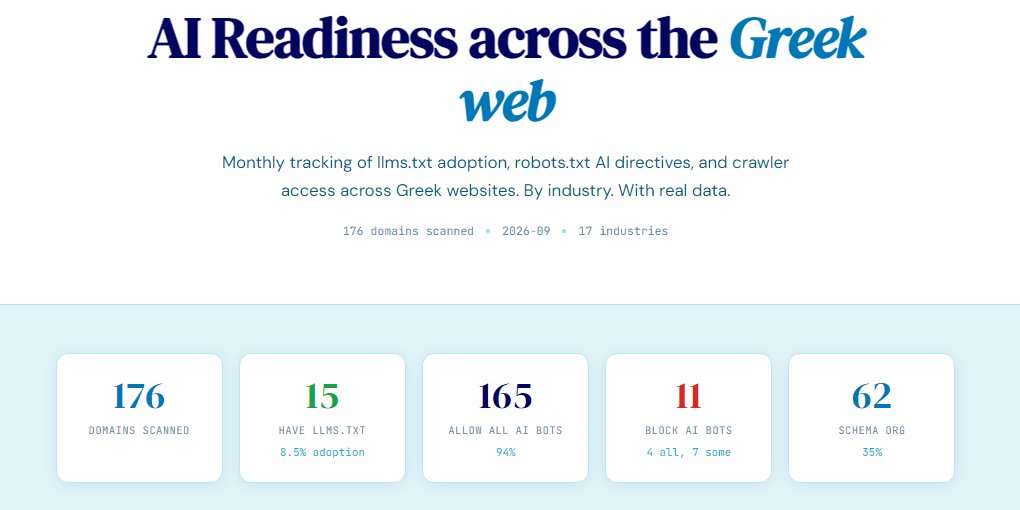
I scanned 176 of the biggest websites in the Greek web to see how ready they are for AI search. Banks, universities, media, retailers, telcos, ferries, the government. Seventeen industries in total.
The picture that came back is a paradox. Greek sites are almost universally open to AI crawlers, and almost universally silent about who they are.
Here is what the data shows and why it matters.
The headline: open doors, no nameplate
Two numbers tell the whole story.
94% allow every AI crawler. Of 176 sites, 165 let GPTBot, ClaudeBot, PerplexityBot, Google-Extended and the rest crawl freely. Only 4 block them all, and 7 block some. Whatever else is true, access is not the problem in Greece.
Only 35% have Organization schema. Just 62 of 176 sites include the structured data that tells an AI system who they are: name, logo, official profiles, the entity behind the content.
Put together, that is the paradox. The machines are allowed in. They just have to guess who they are talking to.
Why Organization schema is the one that matters here
When a language model answers a question about a company, it needs a reliable source for the basic facts. Who is this. What is their official name. What are their verified profiles. Organization schema is that source, handed over in a format the model does not have to interpret.
Without it, the model infers identity from page text, which is slower and less certain, and more prone to mixing you up with someone else. With it, your identity is declared once, unambiguously, and travels with every citation.
For a brand, that is the difference between being represented accurately in an AI answer and being approximated.
The industry breakdown
Sorted by the share of sites that have Organization schema, worst first:
| Industry | Sites | Org schema | llms.txt |
|---|---|---|---|
| Universities | 10 | 0 (0%) | 0 (0%) |
| Government & Public | 9 | 0 (0%) | 0 (0%) |
| Telcos & ISPs | 7 | 1 (14%) | 2 (29%) |
| Insurance | 10 | 2 (20%) | 1 (10%) |
| Travel & Tourism | 18 | 5 (28%) | 2 (11%) |
| Tech & SaaS | 7 | 2 (29%) | 0 (0%) |
| Supermarkets | 10 | 3 (30%) | 0 (0%) |
| Banks & Finance | 9 | 3 (33%) | 0 (0%) |
| Automotive | 13 | 5 (38%) | 2 (15%) |
| Health & Pharma | 8 | 3 (38%) | 1 (12%) |
| E-commerce & Retail | 16 | 7 (44%) | 3 (19%) |
| Energy & Utilities | 9 | 4 (44%) | 1 (11%) |
| News & Media | 25 | 12 (48%) | 1 (4%) |
| Real Estate | 4 | 2 (50%) | 0 (0%) |
| Food & Delivery | 4 | 2 (50%) | 0 (0%) |
| Fashion & Beauty | 8 | 5 (62%) | 1 (12%) |
| Digital Services | 9 | 6 (67%) | 1 (11%) |
The pattern nobody would predict
Look at the top of that table. The two industries with zero Organization schema are universities and government.
These are the institutions where identity is least ambiguous and most authoritative. A public university or a ministry is exactly the kind of entity an AI system should be able to describe with confidence. Yet they hand the model nothing structured to work with. Every university in the sample, every government site in the sample, leaves its identity to inference.
Banks are barely better at 33%, and insurance at 20%. The sectors where trust and correct identification matter most are near the bottom.
Meanwhile the sectors that live or die by online presence, digital agencies at 67% and fashion at 62%, are the ones that bothered. Which makes sense. They feel the competitive pressure first.
The llms.txt gap
The other column is even starker. Only 8.5% of all 176 sites have an llms.txt file. Fifteen sites.
The standard is young, but it is no longer obscure. Google added an llms.txt check to Lighthouse under its agentic browsing audits, which means it is about to become visible to every developer who runs a report. Right now, being one of the fifteen is a genuine head start. In six months it will be table stakes.
Among the fifteen that have one: Vodafone, Toyota, Hertz, Public, BestPrice, Proto Thema, Discover Greece, Doctoranytime, and a handful more. A mixed group, which tells you adoption is still driven by individual initiative rather than any sector norm.
What about the sites that block AI crawlers?
A few do. Kathimerini, MoneyReview, Ferries.gr, Pame Diakopes block everything. Skroutz and Capital.gr block some.
If you are considering the same, one thing worth understanding: blocking AI crawlers in robots.txt is not the same as staying out of AI answers. Blocking GPTBot stops OpenAI’s training and direct crawling, but ChatGPT Search pulls largely from Bing’s index, and Google’s AI Overviews are fed by the regular Googlebot, which is separate from Google-Extended. A block usually costs you training inclusion without giving you the full protection people assume it does.
For a news publisher protecting content, that trade can be deliberate and reasonable. For most businesses, it means opting out of a discovery channel while staying visible anyway through the back door.
What to actually do
If you are a Greek site and you recognise yourself in this data, the fixes are small and one-time.
Add Organization schema to your homepage and About page. It is a single JSON-LD block declaring your name, logo, and official profiles. Our JSON-LD generator produces it, and this guide covers why it matters for AI.
Ship an llms.txt file. A short markdown file at your domain root that tells AI systems what your site is and where the important pages are. The llms.txt generator builds one in minutes.
Check what AI crawlers actually see when they reach you, with a free analysis.
Methodology
The scan covers 176 Greek domains across 17 industries, checked for robots.txt AI crawler rules, Organization JSON-LD, and llms.txt presence. It runs monthly, so these numbers are a snapshot of September 2026 and will move. The live results are in the AI Readiness Observatory.
The gap is not technical difficulty. Everything measured here is a paste-once fix. The gap is that almost nobody has looked. Which, for anyone who does look, is the opportunity.