You can write the best content on the internet. You can add perfect schema markup, build comprehensive internal linking, and earn backlinks from authoritative sources. But if your HTML structure is broken, none of it matters. LLMs can’t extract what they can’t parse.
Structural integrity is the baseline. It’s the foundation that every other optimization depends on.
What structural integrity actually means
Structural integrity refers to how well your page’s HTML communicates its content to machines. Not how it looks to a human in a browser, but how it reads to a parser that processes raw markup.
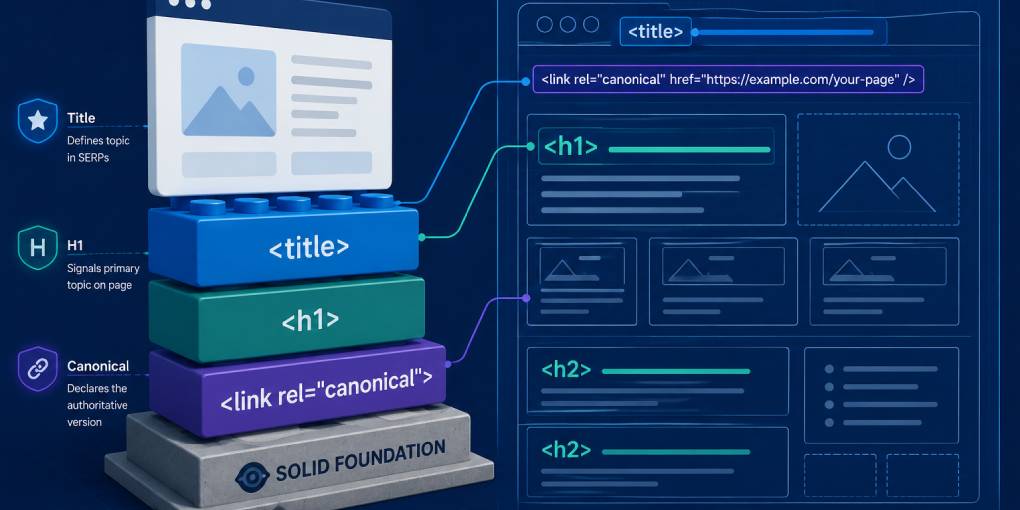
A page with strong structural integrity has a clear title tag, a logical heading hierarchy, proper canonical URLs, complete Open Graph metadata, semantic HTML elements, and correct language attributes. These aren’t advanced optimizations. They’re the basics that tell any machine, whether it’s a search engine crawler or an LLM, what your page is about and how it’s organized.
A page with poor structural integrity might look perfect in a browser but appear as a confusing mess of generic div tags, missing metadata, and ambiguous structure to a machine reader.
Why LLMs are less forgiving than search engines
Google has spent two decades getting better at interpreting messy HTML. It can often figure out what a page is about even when the markup is imperfect. LLMs are not as generous.
When an LLM processes your page, it relies heavily on explicit structural signals. It uses your title tag to understand the topic. It uses heading tags to identify sections and chunk content. It uses canonical URLs to avoid duplicate processing. It uses language attributes to apply the correct linguistic model.
If your title tag is missing, the model has to guess your topic from body text. If your headings are out of order or missing, the model can’t create reliable content chunks. If your canonical URL points somewhere unexpected, the model might attribute your content to a different page entirely.
Search engines degrade gracefully when structure is poor. LLMs often fail silently, skipping your content in favor of a better-structured competitor.
What gets checked
When hey-eye evaluates structural integrity, it looks at specific signals that directly affect how machines parse your page:
Title tag. Does the page have one? Is it within the recommended length? A missing or empty title is the most basic structural failure, and it still happens on millions of pages.
Heading hierarchy. Is there exactly one H1? Do the H2s and H3s follow a logical sequence without skipping levels? Headings are chunk boundaries for LLMs. A page that jumps from H1 to H4 creates a broken outline that models struggle to navigate.
Canonical URL. Does the page declare a canonical? Does it point to itself or to another page? Incorrect canonicals confuse both search engines and LLMs about which version of your content is authoritative.
Open Graph tags. Are og:title, og:description, og:image, and og:url present? These tags aren’t just for social media previews. AI systems use them as quick metadata summaries when deciding whether to process a page further.
Meta description. Is there a meta description? While search engines sometimes ignore it, LLMs often use it as a pre-read summary to decide whether the page is relevant to a query before processing the full content.
Semantic HTML. Does the page use proper HTML elements (article, section, nav, main, aside) or is everything wrapped in generic divs and spans? Semantic elements give machines explicit signals about the role of each content block.
Language attribute. Does the html tag declare a language? This tells LLMs which language model to apply when processing your content. A Greek page without a language declaration might be processed with English language assumptions, degrading extraction quality.
Viewport and charset. Basic but essential. Missing charset declarations can cause encoding issues that corrupt your content for machine readers. Missing viewport meta doesn’t affect LLMs directly but signals a page that may not be well-maintained.
The weight it carries
In hey-eye’s scoring system, Structural Integrity carries a 30% weight, the second-highest pillar after AI Extractability (35%). This weighting reflects a simple truth: structural problems are multiplicative. A page with broken structure scores poorly on extractability too, because the content can’t be properly chunked. It scores poorly on clarity, because the heading density and organization are off. It even affects authority signals, because missing metadata makes the page look poorly maintained.
Fixing structural integrity issues often improves scores across all four pillars simultaneously. It’s the highest-leverage optimization you can make.
The most common failures
After analyzing thousands of pages, certain patterns emerge repeatedly:
Multiple H1 tags. Many CMS templates include the site name as an H1 in the header, then the page title as another H1 in the content. Two H1s create ambiguity about the page’s primary topic.
Missing Open Graph tags. Sites that never share content on social media often skip OG tags entirely. But AI systems use these tags too, so missing them affects more than just social previews.
Self-referencing canonical issues. Pages that don’t declare a canonical at all, or pages where the canonical points to a different URL due to trailing slashes, www vs non-www, or HTTP vs HTTPS mismatches.
Heading level skipping. Designers who choose heading levels for visual size rather than semantic hierarchy. An H1 followed by an H4 because “H4 looks right” creates a broken document outline.
Fix the foundation first
If your hey-eye score shows a weak Structural Integrity pillar, fix it before touching anything else. The improvements are usually simple (add a missing tag, fix a heading level, declare a canonical) and the impact cascades across every other pillar.
Structure isn’t the exciting part of AI visibility. But it’s the part that makes everything else possible.