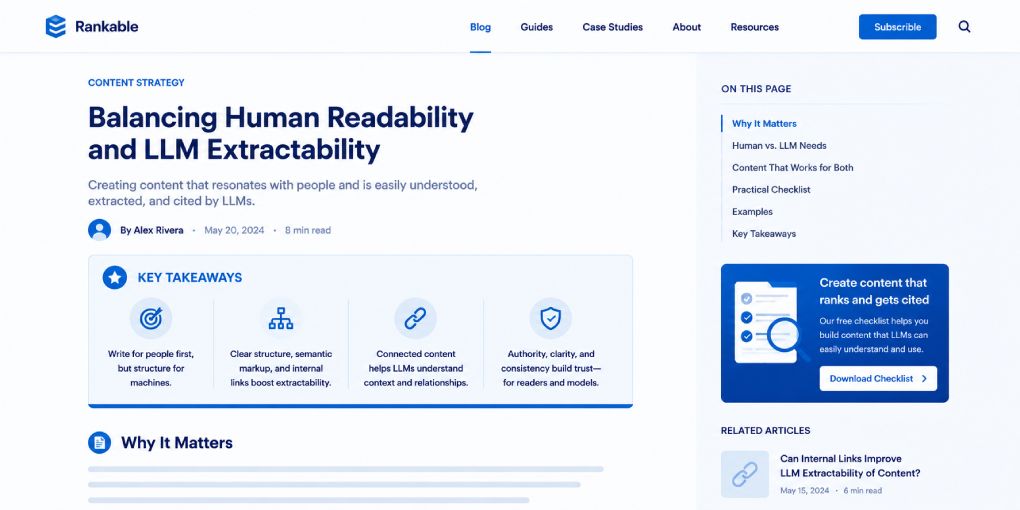
You’ve seen them on medical sites, recipe pages, and product reviews. A short box at the top of the article that says “Key takeaways” or “In brief” followed by three to five bullet points. Most people skip them. LLMs don’t.
Summary boxes are one of the most effective and underused techniques for improving AI extractability. They work because they give models exactly what they need: a pre-packaged, self-contained answer that requires zero interpretation.
Why LLMs love summary boxes
When an LLM processes a 2,000-word article, it faces a chunking problem. The answer to a user’s question might be spread across four paragraphs in three different sections. The model has to locate, combine, and rephrase that information. It can do this, but the result is less likely to include a direct citation because the model had to synthesize rather than extract.
A summary box eliminates that work. The key points are already condensed, already grouped, already phrased as standalone statements. The model can extract the entire box or any single bullet and attribute it directly to your page.
This is why pages with summary boxes consistently receive more AI citations than equivalent pages without them. The content quality is the same. The packaging is better.
What a good summary box looks like
The format is simple. Place it immediately after your H1 or opening paragraph. Keep it visually distinct from the body text. Use a background color, border, or slight indent to signal that this is a structural element, not regular prose.
The content should follow these rules:
3-5 bullet points. Fewer than three feels thin. More than five defeats the purpose of being concise.
One idea per bullet. Each point should be a complete, quotable statement. Not a teaser, not a fragment.
No jargon that requires context. Someone reading only the summary box should understand every point without reading the article.
Answer the title question. If your article title asks a question, the summary box should contain the answer. If it makes a statement, the box should contain the supporting evidence.
HTML implementation
You don’t need a plugin or framework for this. A simple semantic pattern works:
<aside class="summary-box" aria-label="Key takeaways">
  <h2>Key Takeaways</h2>
  <ul>
    <li>Summary boxes increase LLM citation rates by packaging answers as extractable units.</li>
    <li>Place them immediately after the H1 or opening paragraph.</li>
    <li>Keep each bullet self-contained and jargon-free.</li>
    <li>Use semantic HTML with a distinct visual treatment.</li>
  </ul>
</aside>
The <aside> tag tells the model this is supplementary, structured content. The aria-label adds accessibility context. The heading inside the box helps models understand its purpose.
For styling, a light background, left border, and slightly smaller font size work well. The goal is visual separation without distraction.
Where summary boxes help most
Not every page needs a summary box. They’re most effective on:
Long-form content. Articles over 1,000 words benefit the most because the alternative (reading the full text) is costly for both humans and models.
How-to guides. When someone asks an LLM “how do I do X,” a summary box with numbered steps is the ideal extraction target.
Comparison content. “X vs Y” articles where the key differences can be stated in bullet form. Models frequently extract these for side-by-side answers.
FAQ-style content. Pages that answer multiple related questions. The summary box acts as a quick-reference table that models prefer over scanning individual sections.
They’re less useful on short posts under 500 words (the whole post is already concise) or on pages where the content is primarily visual (portfolios, galleries).
The compound effect
Summary boxes don’t just help with AI extraction. They improve human engagement metrics too. Readers who see a clear summary at the top are more likely to keep reading because they know the article contains what they’re looking for. Lower bounce rates, higher time on page, better scroll depth.
Those engagement signals feed back into search rankings and source credibility assessments by LLMs. A summary box improves extractability directly by providing a clean extraction target, and indirectly by improving the behavioral signals that models use to evaluate source quality.
Start with your highest-traffic posts
You don’t need to add summary boxes to every page at once. Start with your top ten posts by traffic or the pages you most want LLMs to cite. Add a summary box, re-scan with hey-eye, and measure the score change. The improvement is usually immediate and visible in the AI Extractability pillar.
A few bullet points at the top of your page. That’s all it takes to go from readable to extractable.