When a language model cites a source, it is making a claim on your behalf. It is telling a user that this information came from somewhere specific and that the somewhere is worth naming.
That decision requires an entity to attribute to. A page written by nobody, published on no particular date, maintained by no identifiable person, is harder to cite than a page that answers all three questions before the model has to ask. Not impossible. Just harder, and models take the easier path when several sources say the same thing.
Author signals are how you answer those questions. Most sites answer none of them.
For the wider set of credibility factors, see what authority and trust mean in AI search. This article goes deep on one of them.
The four layers of author signal
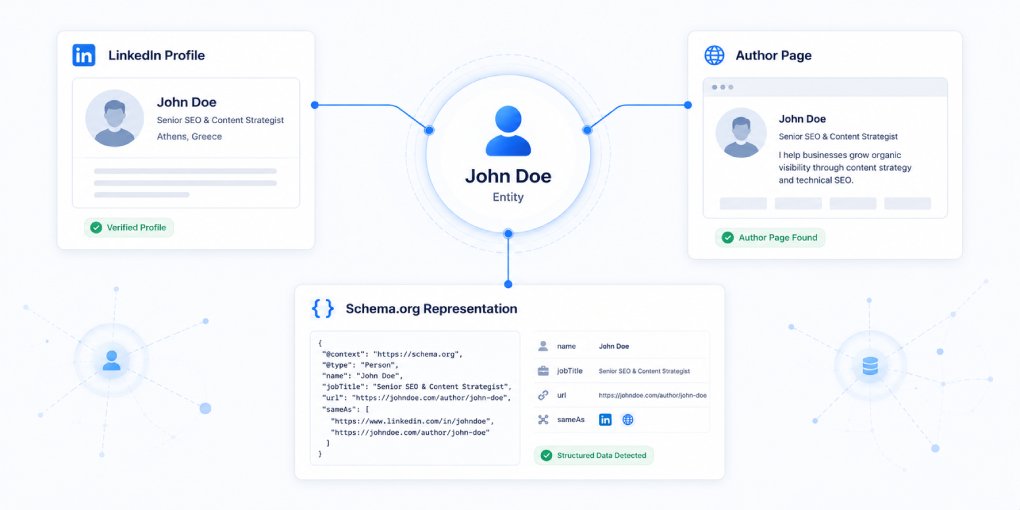
Author identity is not a single field. It is a stack, and each layer corroborates the one below it.
The visible byline. A name on the page, readable by a human. This is the weakest signal on its own because a model has to infer that the string near the top of the article is an author rather than a subject, but it is also the layer most often missing entirely.
The structured declaration. An author object inside your Article JSON-LD, typed as Person, with a name and a url. This removes inference. The model does not guess who wrote the page, it reads it. This is the highest-value layer relative to the effort it takes.
The author page. A URL that describes who this person is, what they do, and why they are qualified to write about the subject. The url field in your schema should point here or to an equivalent profile. Without a destination, the author is a string. With one, the author is a documented entity.
External corroboration. Links from the author page to profiles elsewhere: LinkedIn, a company page, GitHub, ORCID, published work. This is what lets a model connect the name on your site to a person that exists independently of your site. A name that appears only on your own domain is unverifiable by definition.
Each layer without the ones below it is weaker than it looks. A schema author field pointing at a URL that 404s is worse than no field at all, because it declares something the model can check and fail.
Why entity resolution is the real mechanism
The underlying process is not “does this page have an author.” It is entity resolution: can the model connect this name to a known entity, and does that entity have any established relationship to this subject?
This is why consistency matters more than volume. An author who writes ten articles on one domain under a name that appears nowhere else has produced ten unverifiable pages. An author whose name, on the same domain, resolves to a LinkedIn profile describing fifteen years in the field has produced ten pages attached to a real person with relevant background.
Two practical consequences follow.
Use one form of your name everywhere. “Xenofon Tsimpogiannis” on the site, “Akis T.” on LinkedIn, and “X. Tsimpogiannis” in bylines are three entities as far as resolution is concerned. Pick one and use it consistently, including in the name field of your schema.
Keep the topic consistent. An author associated repeatedly with one subject area accumulates a topical association. An author whose byline appears across unrelated subjects accumulates none.
What a complete implementation looks like
In your Article schema:
"author": {
  "@type": "Person",
  "name": "Your Full Name",
  "url": "https://yoursite.com/about/"
}
On your author or About page, an Organization or Person block with sameAs pointing to your external profiles:
"sameAs": [
  "https://www.linkedin.com/in/yourprofile/",
  "https://github.com/yourhandle"
]
And on the page itself, a visible byline with a link to the same URL your schema declares. The visible content and the structured data should agree. When they disagree, the mismatch is itself a negative signal.
The mistakes that cost the most
“Admin” or the site name as author. A Person typed entity called “Admin” resolves to nothing. If the content genuinely has no individual author, use Organization and be accurate rather than typing a placeholder as a person.
Author in the visible text but not in schema. Very common. The byline is right there on the page but the JSON-LD omits the field entirely, so the model has to infer what it could have simply read.
Author present on blog posts, absent everywhere else. Landing pages, resource pages, and documentation routinely omit author fields even when the blog includes them. If those pages are the ones you want cited, they need the signal too. This is worth checking specifically, because the gap is invisible unless you compare templates side by side.
An author page that says nothing. A bio reading “writer and enthusiast” gives a model no basis for evaluating expertise. State the actual credential: years in the field, role, relevant work.
Missing dates alongside missing authors. These two travel together in practice, and they fail together. A page with neither an author nor a publication date is an orphan document regardless of how good the content is.
Where this fits against everything else
Author signals will not rescue a page that cannot be crawled, cannot be parsed, or has nothing worth extracting. Trust is a filter applied to content that already cleared the earlier gates, not a substitute for clearing them.
But among sources that all cleared those gates and all say roughly the same thing, attribution is often what separates the one that gets named from the ones that get absorbed silently.
Check where you stand by running your pages through hey-eye and looking at the Authority and Trust pillar, which reports author attribution alongside the other credibility signals. If you need to add or complete the schema, the JSON-LD generator produces the author block in the correct format.
Start with your highest-traffic pages that currently have no author field. It is a five-line addition and it is the difference between content that can be attributed and content that cannot.