A few months ago I made a decision about this blog: stop writing explainers and only publish articles built on data nobody else has. Bot logs, crawls, scans, my own analytics.
That was a bet. Now there is enough data to check it.
I took two Search Console exports, one month apart, and split every blog article into two groups. Then I compared them.
The two groups
Original data. Articles built on my own measurements: verifying real AI crawlers against spoofed bots, system prompts leaking into Search Console, a scan of 176 Greek websites, llms.txt examples from real sites, and the three most recent data pieces. Seven articles in total.
Generic how-tos. Everything else. Guides on headings, schema, robots.txt, extractability, meta tags. Useful, accurate, and similar to what many other sites publish. 54 articles.
The comparison uses the Search Console exports from October 2 and November 3, 2026. Each covers the three months before it, so the difference shows what the newest month added. All figures below are percentages or ratios.
The results
| Original data | Generic how-tos | |
|---|---|---|
| Impressions change in one month (group total) | +76% | +11% |
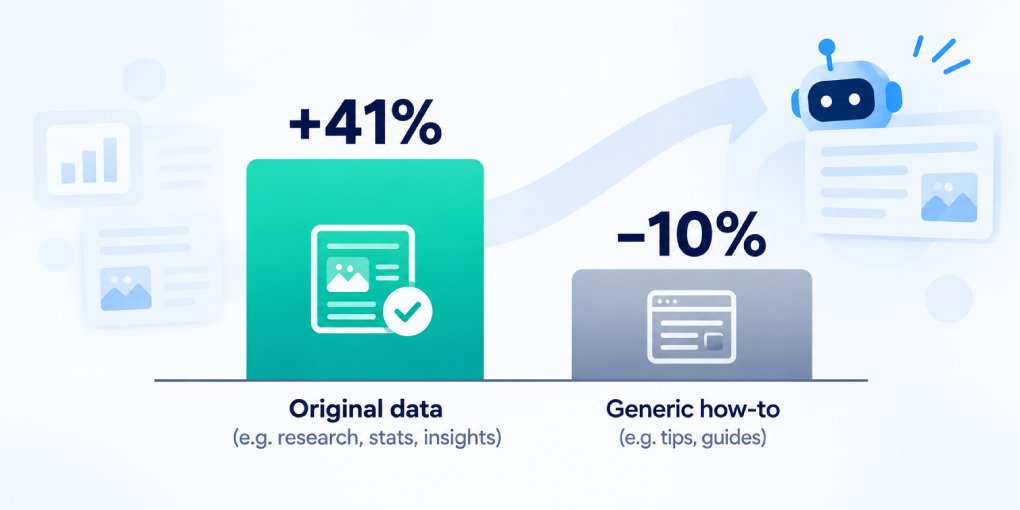
| Impressions change (median article) | +41% | -10% |
| Articles that lost impressions | none | 24 of 44 |
| Average position | 14.5 | 26.5 |
| Share of impressions from AI features | 24% | 14% |
Original data is growing. Every original article that existed in both exports held or gained impressions. As a group they grew by three quarters in a single month.
Generic how-tos are stalling. The group total still grew a little, but almost entirely because of one article. The typical how-to lost a tenth of its impressions, and more than half of them declined.
Original data ranks higher. An average position of 14.5 against 26.5. On a small site with little authority, that is the difference between page two and page three.
The standout case
One article explains a lot of these numbers on its own.
The piece on spoofed AI crawlers was built entirely from my own Cloudflare data. Within two weeks of publishing, it was ranking at the top for questions that are near paraphrases of its subject. One month later:
- Its impressions had grown roughly six times.
- About half of them came through AI Overviews and AI Mode.
- New questions kept appearing around it, such as “tool to distinguish legitimate ai crawlers from spoofed bots” and “which platforms verify whether an ai bot is real or spoofed?”, both on page one.
No generic how-to on this site has behaved like that.
Where the data does not back me up
I wanted the headline to say “AI picks up original data.” The numbers only partly support it.
The AI advantage rests mostly on one article. As a group, original articles get 24% of their impressions from AI features, against 14% for how-tos. But remove the spoofed crawlers piece, and the remaining original articles sit at around 8%, which is lower than the how-tos. The typical article in each group has about the same AI share.
Neither group produces clicks. Click-through rate is low on both sides and slightly lower for original data. Being found more often has not, so far, turned into visits.
The three newest data articles are too young. They were published in October, so most of the comparison window predates them. They will count properly next month.
So the honest conclusion is narrower than the one I wanted, and more useful: original data grows and ranks better. Whether it gets cited by AI more often depends heavily on whether it answers a question nobody else answers.
Why original data grows
A few reasons, and they fit together.
There is no competition for your own numbers. A guide to JSON-LD competes with hundreds of similar guides, many from sites with far more authority. A dataset from your own logs exists in one place. Any system looking for that fact has one source to choose.
It creates its own questions. Once the spoofed crawlers article was out, questions about telling real crawlers from fake ones started appearing in Search Console. Original findings give people, and machines, something new to ask about.
Specific beats general. Data articles answer narrow questions precisely: which bots, what share, what happened. Narrow questions are exactly what long, conversational queries ask.
Generic content decays. How-tos compete with every new version of the same advice, including AI answers that summarise all of them at once. Once the answer is common knowledge, there is little reason to show any one page for it.
What I take from this
Stop adding to a pile that is shrinking. If more than half of your generic how-tos are losing visibility, writing one more is unlikely to change the trend.
Your own data is your moat. Server logs, analytics, scans, experiments. Things that only your site can measure are the content nobody can copy or out-rank.
Expect visibility, not traffic. Original data earned more impressions and better positions here. It did not earn more clicks. Plan for authority and citations first.
One strong finding can carry a lot. The spoofed crawlers article did more for this site in a month than dozens of guides. It is worth spending the time to find the one number that surprises people.
I will rerun this comparison next month, when the newest data articles have a full window behind them.
If you want to see how well your own pages are structured for the questions AI systems ask, run them through hey-eye.