JSON-LD schema exists on millions of websites. Most of it is auto-generated by CMS plugins, minimally configured, and largely ignored after installation. It satisfies a checkbox but doesn’t drive results.
For generative search engines like ChatGPT, Perplexity, Google AI Overviews, and Claude, schema isn’t a checkbox. It’s the primary structured data layer they use to understand your content before processing a single paragraph. The schema types you choose, how completely you implement them, and how they work together determine whether AI systems can efficiently extract and cite your content.
Not all schema is created equal. Here’s what works, ranked by impact.
How generative search engines use schema
Traditional search engines use schema to generate rich results: star ratings, FAQ dropdowns, recipe cards. The schema enhances how your page appears in results but doesn’t fundamentally change whether Google understands your content.
Generative search engines use schema differently. When ChatGPT, Perplexity, or Google AI Overviews retrieves your page, the JSON-LD block is processed first, before the body content. It serves as a machine-readable summary that tells the AI system:
- What type of content this is (article, product, FAQ, how-to guide)
- Who created it and when
- What topics it covers
- How it relates to other content on your site
This pre-processing step determines how the AI system chunks, interprets, and attributes your content. A page with complete schema gets processed with full context. A page without schema gets processed blind, and blind processing produces fewer citations.
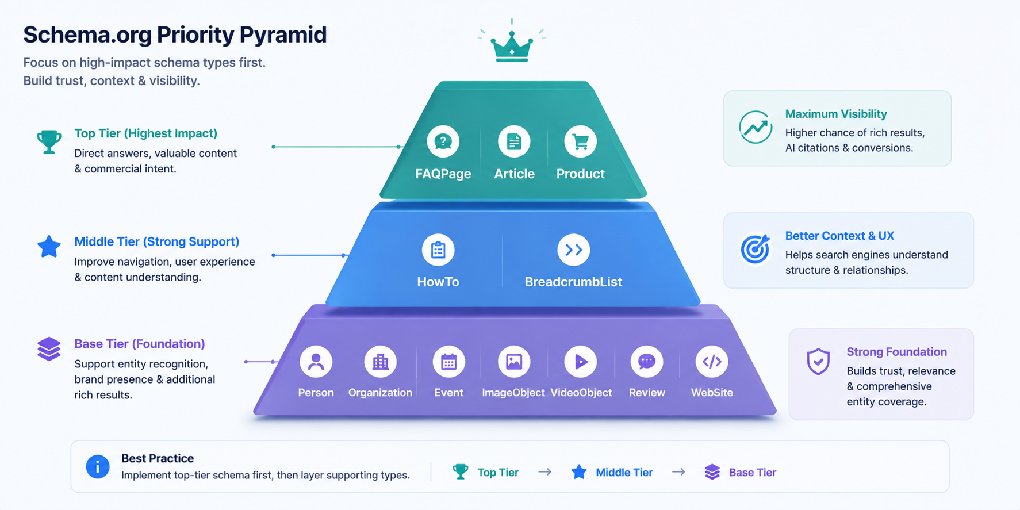
Tier 1: Highest impact schemas
These schemas produce the most measurable improvement in AI citations. Implement them first.
FAQPage
The single most impactful schema for AI citations. FAQ schema provides pre-structured question-answer pairs that models can extract directly without any reformulation.
When a user asks an LLM a question that matches one of your FAQ entries, the model can pull the answer verbatim from your schema. No parsing, no chunking, no interpretation. Direct extraction, direct citation.
Best for: Service pages, product pages, knowledge base articles, any page that answers common questions.
Impact: Pages with FAQPage schema receive disproportionately more AI citations than pages with any other schema type, because the Q&A format maps directly to how people query AI assistants.
Article / BlogPosting
The foundation schema for any written content. Article and BlogPosting provide headline, author, publication date, description, and publisher information in a structured format.
Generative search engines use these fields for source evaluation: Is this content recent? Who wrote it? Is the publisher credible? Without Article schema, the AI system has to infer all of this from page content, which is slower and less reliable.
Best for: Blog posts (BlogPosting), news content (Article or NewsArticle), opinion pieces, guides, and any long-form written content.
Impact: Article schema doesn’t directly increase extraction rates, but it increases attribution accuracy. Models cite sources more confidently when they have structured metadata about the author and publication date.
Product
Essential for e-commerce. AI shopping agents read Product schema to compare prices, check availability, and evaluate options across sites without scraping visual layouts.
Product schema with complete offers data (price, currency, availability) gives shopping agents everything they need in one structured block. Sites without it force agents to parse price from visual elements, which is slow and error-prone.
Best for: Any page that sells or describes a product.
Impact: For e-commerce sites, Product schema is the difference between being included in AI-powered comparison shopping and being skipped entirely.
Tier 2: Strong supporting schemas
These schemas don’t drive citations on their own but significantly strengthen the pages they appear on.
HowTo
Step-by-step instructions in a structured format. AI assistants frequently pull HowTo schema when users ask “how do I…” questions. Each step has a name and description, creating individually extractable instruction units.
Best for: Tutorial pages, installation guides, recipe pages, DIY instructions, any procedural content.
Impact: High for instructional queries. Models prefer structured steps over parsing numbered lists from body text.
BreadcrumbList
Tells AI systems where a page sits in your site hierarchy. Home > Category > Subcategory > Page. This context helps models understand topical relationships and improves citation accuracy by providing navigational context.
Best for: Every page that has breadcrumb navigation. Implementation should mirror the visible breadcrumbs.
Impact: Moderate individually, but compounds across your site. A full site with BreadcrumbList on every page gives AI systems a complete map of your content structure.
Organization
Declares who you are as an entity: name, logo, social profiles, contact information. AI systems use this to build a knowledge graph entry for your brand and to verify that the entity behind the content is real and established.
Best for: Homepage and About page.
Impact: Indirect but foundational. Organization schema contributes to the trust signals that influence whether AI systems cite your content at all.
Tier 3: Situational schemas
Use these when your content matches their specific purpose.
LocalBusiness
For businesses with physical locations. Includes address, hours, phone, service area. Increasingly important as AI assistants handle local queries (“find a plumber near me,” “is this store open?”).
Event
For pages describing events with dates, locations, and ticket information. AI assistants that help with planning and scheduling pull Event schema directly.
Review
Individual review markup (not just aggregateRating) gives AI systems detailed social proof to present alongside product or service information.
VideoObject
For pages with embedded video content. Includes name, description, duration, thumbnail. AI systems can reference video content more accurately when it has structured metadata.
Combining schemas on one page
A single page can and often should have multiple schema types. A blog post that includes an FAQ section should have both BlogPosting schema (for the article metadata) and FAQPage schema (for the Q&A pairs). A product page with customer questions should have both Product and FAQPage.
The schemas don’t conflict. Each one provides a different layer of structured information. Together, they give AI systems a complete, multi-dimensional understanding of your page.
The one rule: each schema block should be accurate and consistent with the visible page content. Don’t add FAQPage schema if the page doesn’t actually display Q&A content. Don’t add Product schema to a blog post. The schema should describe what’s genuinely on the page.
Implementation priority
If you’re starting from zero, implement in this order:
- Article/BlogPosting on every content page (5 minutes per page with the JSON-LD generator)
- FAQPage on any page that answers questions (highest citation impact)
- Product on every product page (essential for shopping agents)
- BreadcrumbList on every page with navigation breadcrumbs
- Organization on your homepage and About page
- HowTo on tutorial and guide pages
- Everything else as your content requires
For ready-to-use code examples of each type, see JSON-LD Schema Examples for Every Content Type.
Validating your implementation
After adding schema, verify it works:
- Google Rich Results Test checks syntax and required fields
- hey-eye checks whether schema is detected and scores its impact on your AI Extractability pillar
- Manual LLM testing: ask ChatGPT or Claude about your page’s topic and see if your content gets cited
Run a website audit to see which pages have schema and which don’t. The audit reveals gaps across your entire site so you can prioritize implementation by traffic and importance rather than guessing which pages need attention.
Schema is the language AI systems speak natively. The more fluently your pages speak it, the more confidently those systems will cite them.