An audit is not a comparison and it is not a tracking exercise. It is a bounded examination that starts with a question, produces findings, and ends with a remediation list you can hand to someone.
For LLM visibility that means answering one thing: in the queries that matter to my business, who gets cited, what do they have that I do not, and which of those gaps can I close.
This is how to run one. Budget half a day.
If you want the reasoning behind why competitor position matters in AI search at all, this article covers it. This one assumes you are convinced and want the procedure.
Phase 0: Scope it before you touch a tool
Most audits fail here, by trying to cover everything and producing findings too diffuse to act on.
Pick five to ten questions your customers actually ask. Not keywords, questions, phrased the way someone would ask an assistant. These define the boundary of the audit.
Pick a maximum of four competitors. More than that and the pattern analysis in Phase 3 becomes noise.
And write down what decision the audit will inform. “Should we invest in schema across the site” is a decision. “Understand the competitive landscape” is not, and an audit aimed at it will produce a document nobody uses.
Phase 1: Find out who actually gets cited
Your assumed competitors and your LLM competitors are often different sets.
Take your five to ten questions and ask each one to ChatGPT, Claude, Perplexity and Google AI Mode. Record every domain that gets cited, and how often.
Two things usually surface. Sites you did not consider competitors, often smaller and better structured than you expected. And absences, meaning large competitors you assumed dominate the space that turn out never to be cited.
The cited set is your audit population. Not your SEO competitor list, not the top ten organic results.
Phase 2: Scan at domain level first
Resist the urge to start comparing individual pages. You are looking for systematic differences, and those only show up at scale.
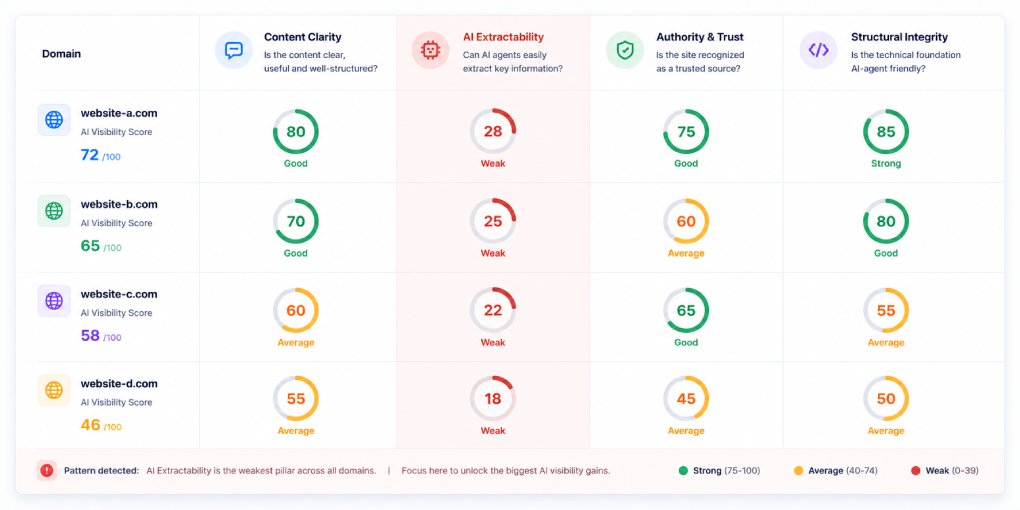
Run a website audit on each competitor domain and on your own. This crawls each sitemap and scores every page across the four visibility pillars, which gives you distributions rather than anecdotes.
Record four numbers per domain: median overall score, median score per pillar, percentage of pages carrying JSON-LD schema, and the spread between best and worst page.
That last number matters more than people expect. A competitor with a median of 70 and a tight spread is systematically well built. One with a median of 70 and a spread from 20 to 95 has a few strong pages and a lot of weak ones, which is a different competitor and a different threat.
Phase 3: Compare the pages that actually overlap
Now go page level, but only where you genuinely compete.
For each of your scoped questions, identify the competitor page that gets cited and your equivalent page. Run them through Compare and record the pillar scores side by side. How to read a two-page comparison covers what the output means in detail.
Aim for eight to fifteen pairs. Fewer and you cannot distinguish pattern from coincidence.
Phase 4: Extract patterns, not incidents
This is the analytical work and the part that separates an audit from a pile of scans.
Look down your columns and ask what repeats.
Does one pillar lose consistently? Losing AI Extractability in twelve of fifteen pairs is one finding, not twelve. It usually points at schema, and which schema types matter most tells you where to start.
Do their cited pages share structural traits yours lack? Common ones are FAQ schema on guide pages, visible author attribution with a real profile behind it, breadcrumb markup, and paragraphs consistently under a hundred words. Author signals in particular are absent from most sites and cheap to add.
Does the gap cluster by page type? If their blog beats yours but your product pages beat theirs, the finding is about templates, not content.
Phase 5: Write the findings
An audit that ends in a spreadsheet is not finished. Produce a short document with four sections.
What we found. Three to five patterns, each stated as a claim with the evidence behind it. “Competitors carry FAQ schema on 80% of guide pages, we carry it on none.”
What it costs us. Where those gaps plausibly explain citation differences, stated honestly. Some gaps will not matter, and saying so is what makes the rest credible.
What we will fix. Ordered by effort against reach. Template-level fixes first, since one change moves many pages.
What we will not fix. The gaps you are consciously accepting. Without this section every future audit reopens the same arguments.
After the audit
An audit is a snapshot. Competitors keep working, so the findings decay.
Convert it into something recurring by tracking your key pages in Scan History and re-running comparisons on a schedule. The benchmarking framework covers that ongoing version, which is a different discipline from the one-off audit and easier to sustain once the audit has told you what to watch.
And before auditing anyone else, it is worth auditing your own site properly. Half the gaps you will attribute to competitive disadvantage turn out to be your own unfixed template issues.
Start narrow
If half a day is more than you have, run a reduced version. Three questions, one competitor, five page pairs. That is enough to reveal whether a systematic gap exists, and if it does, the full audit becomes easy to justify.
Begin with a single comparison against whoever currently gets cited for your most important question.